Keeping Dental Implants Healthy for Decades: A Care Guide for Los Altos Patients
· Eclat Dental Studio
For Los Altos patients with implants: the daily routine, what maintenance visits involve, and the early warning signs of peri-implantitis worth acting on.
An implant is often described as the closest thing to a natural tooth, and in daily life that is how it should feel. What surprises some patients is that the work does not end once the crown goes on. The titanium post cannot decay, but the gum and bone that hold it in place can become inflamed, and that is where long-term success is won or lost. For patients in Los Altos who have one implant or a full arch, this guide covers the habits, visits and warning signs that keep an implant stable for many years.
Why an implant needs its own kind of attention
A natural tooth is suspended in its socket by a thin ligament that carries blood supply and helps the surrounding tissue fend off bacteria. An implant has no such ligament; the bone bonds directly to the post. That is what makes it so steady, but it also means the tissue around it is somewhat less able to resist infection. When plaque sits at the gumline of an implant, inflammation tends to develop more quickly, and once bone begins to recede it is difficult to rebuild.
The typical story we hear is a quiet one. An implant is placed well, cared for carefully in the first few years, and then routine visits slip. Years later the gum around it starts to bleed or feel tender. Nothing about this is inevitable, and preventing it is far simpler than treating it.
A daily routine that protects the gumline
Brushing
Twice a day, use a soft brush or an electric brush on a gentle setting. Angle the bristles toward the gum so they sweep the spot where the crown meets the tissue, since that small collar is where trouble usually begins. A fluoride toothpaste without harsh whitening grit is the better choice, because coarse particles can roughen the crown and the exposed parts of the implant.
Cleaning between
This is the step that matters most and the one most often skipped. A toothbrush cannot reach the sides of the implant, and those surfaces collect plaque every day. Choose whichever tool you will actually use:
- Floss, either plain unwaxed or a type made for implants, curved around the post and guided a little below the gum.
- Small interdental brushes with a plastic-coated wire, which will not scratch the metal.
- A water flosser on a comfortable setting, pointed straight at the gumline.
If you have a fixed full-arch bridge, a water flosser together with a floss threader is usually the most practical way to clean underneath it. Our guide to full-arch implant recovery covers those early weeks in more detail.
Rinsing
An alcohol-free antibacterial rinse can be useful shortly after surgery. Over the long term, water is fine for most people. Rinses with a high alcohol content can dry the soft tissue and irritate the gum around the implant, so they are best avoided.
What happens at an implant maintenance visit
A cleaning around implants is not quite the same as a cleaning on natural teeth. We use instruments designed for implant surfaces and keep ultrasonic settings low, so the biofilm comes away without scratching the metal. Glycine powder polishing is a common choice because it lifts bacteria gently.
The examination side is just as important. At these visits we:
- Check that the crown or bridge is secure and the bite on it is even.
- Measure the gum pocket around each implant and watch for changes from one visit to the next.
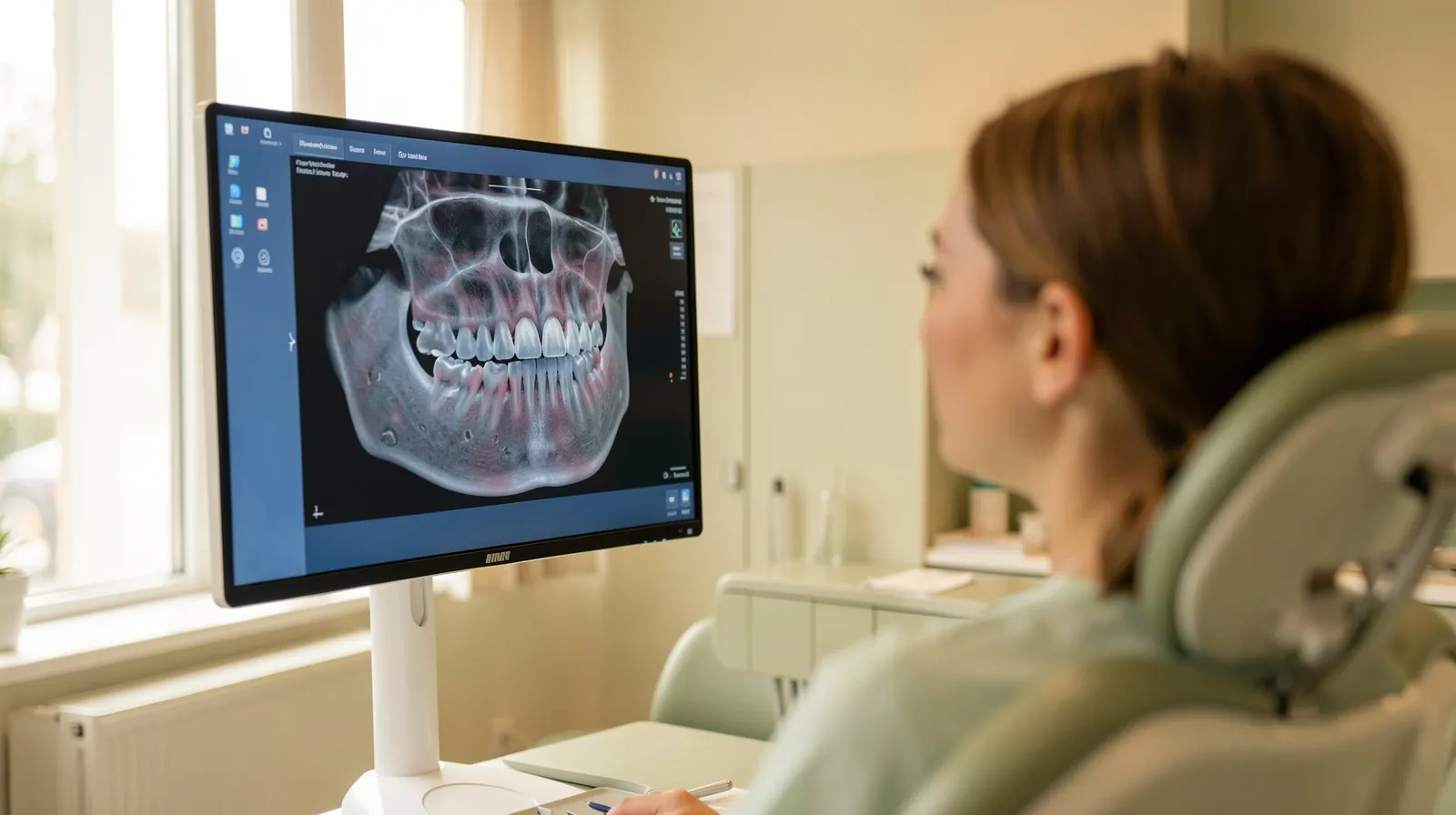
- Take X-rays at sensible intervals to confirm that the bone level is holding.
- Look for early redness or bleeding while it is still easy to reverse.
Long-term research has found that people who keep regular maintenance appointments develop peri-implantitis much less often than those who do not. Inflammation of the gum alone can usually be settled; lost bone generally cannot be regrown in the same way.
How often to come in
Twice a year is the baseline for most implant patients. A three- or four-month interval often suits people with a history of gum disease, diabetes, or plaque that builds quickly. We set the interval with you and revisit it as things change. If you have had gum treatment before, our overview of implant and periodontal care explains how the two are linked.
Early signs of peri-implantitis
Peri-implantitis is an infection of the gum and bone around an implant. It often progresses without pain, which is exactly why regular checks matter. Call us if you notice any of the following:
- Bleeding when you brush or floss around the implant. Healthy tissue around an implant should not bleed.
- Redness, puffiness or tenderness in the gum next to it.
- The gum pulling back so that more of the crown, or a sliver of metal, becomes visible.
- A bad taste, persistent odour, or pus from the area.
- Any movement of the crown, or a change in how your bite feels on that tooth.
A loose crown is sometimes only a loose screw rather than a problem with the implant itself, but either way it should be looked at promptly.
Habits that raise the risk
- Smoking and vaping. Tobacco is the largest risk factor you can change, and smokers develop peri-implantitis considerably more often.
- Diabetes that is not well controlled. Unstable blood sugar weakens the gum's defences and slows healing.
- Grinding at night. Heavy forces can overload an implant and the bone around it. A custom night guard is a modest step that protects a significant investment.
- Using teeth as tools. The crown on an implant can chip if it is used to crack ice or open packaging.
If any of these apply, mention them at your next visit so we can adjust your plan.
Questions we are often asked
Is some bleeding normal around an implant?
No. Occasional bleeding may seem minor, but around an implant it is usually the first sign of inflammation and deserves a look.
My implant feels fine. Do I still need maintenance visits?
Yes. Peri-implantitis can advance quietly, and by the time an implant hurts or moves, bone may already have been lost.
Can I use ordinary floss?
Yes. Glide it gently rather than sawing back and forth, which can irritate the tissue around the post.
Looking after your implant with us
We see implant patients from Los Altos and across the area at our Mountain View studio, just off El Camino Real. Whether your implant was placed here or elsewhere, we are glad to assess it, set a maintenance rhythm and show you the cleaning tools that suit your mouth. Call (650) 917-8348 to arrange a visit.