Loose Dentures and Implants: A Guide to Overdentures for Los Altos Hills Patients
· Eclat Dental Studio
For Los Altos Hills denture wearers: why dentures loosen over time, how a few implants can hold one steady, and how an overdenture compares with a traditional denture.
Many people who wear a complete denture know the pattern well. It fitted comfortably at first, then gradually began to rock, click or trap food, and the adhesive went from occasional to daily. If that sounds familiar, you are not doing anything wrong. Dentures loosen for a predictable biological reason, and there is a well-established way to make them stable again: anchoring them to a small number of implants. This guide explains how that works for patients in Los Altos Hills and nearby, and how an implant-retained overdenture compares with a traditional one.
Why a denture that once fitted now slips
Tooth roots stimulate the jawbone every time you bite. When teeth are removed, that stimulation stops and the ridge of bone beneath the gum slowly shrinks. A denture is shaped to sit on that ridge, so as the ridge flattens, the denture has less to grip.
The lower jaw is usually affected most. A lower denture sits on a narrow strip of bone, and the tongue and cheeks move against it constantly. That is why so many people find their lower denture far more troublesome than their upper one.
Two approaches, side by side
A traditional denture
A conventional denture rests on the gums and is held by suction, muscle control and often adhesive. It has real advantages: no surgery, a shorter timeline and a lower initial cost. The trade-offs are that chewing force is limited, sore spots can develop, and the bone underneath continues to shrink, so relines and replacements become part of life.
An implant-retained overdenture
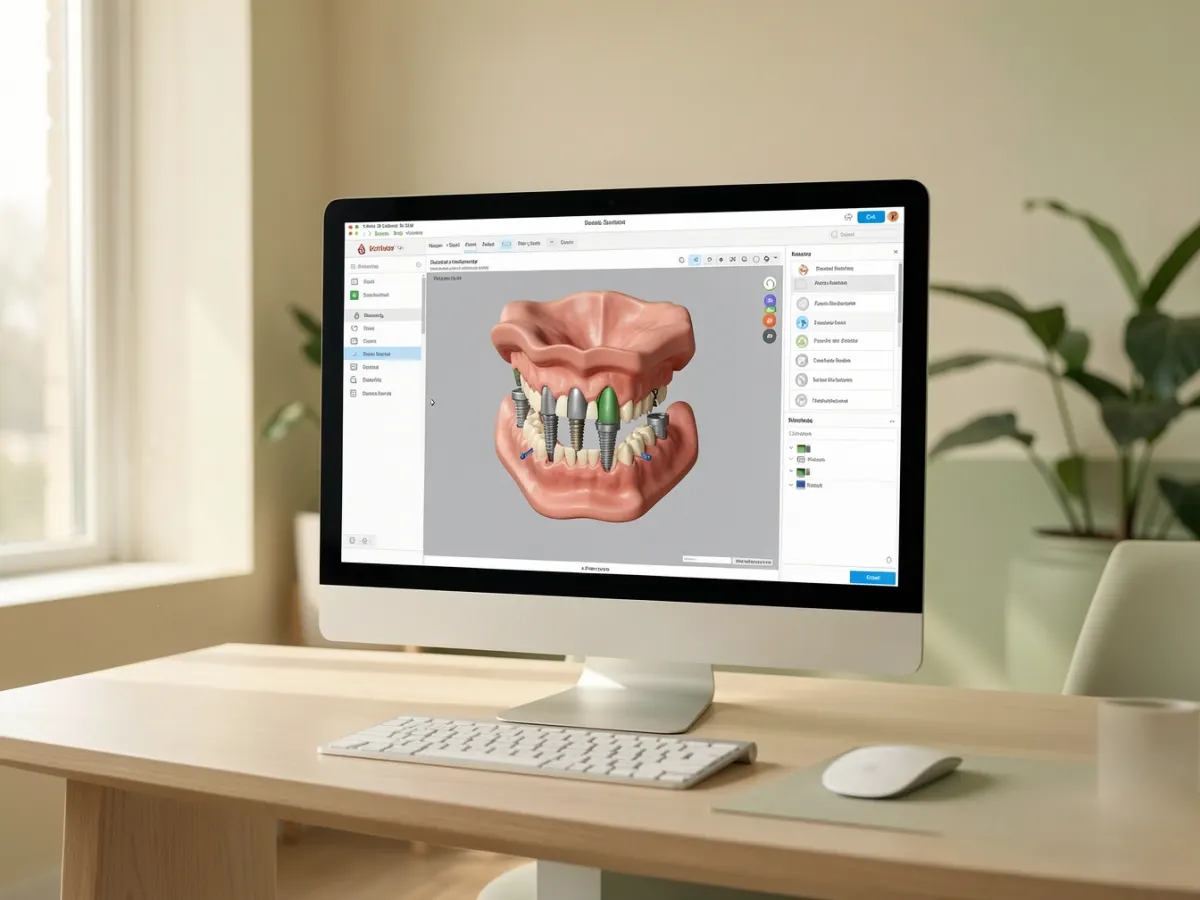
An overdenture looks much like a standard denture, but the fitting surface contains small attachments that clip onto implants in the jaw. You still remove it each day to clean it. The difference is that it stays where it should while you eat and speak.
- Lower jaw: two implants in the front of the jaw are widely regarded as a first-line option for a lower denture. Research suggests that adding a third or fourth implant in the lower jaw does not change stability much for most patients, although extra implants can help in particular situations.
- Upper jaw: the bone is softer, so an upper overdenture is usually supported by four implants.
- Attachments: the most common design uses small button-like abutments on each implant, with nylon inserts in the denture that snap on and off. Bar and ball designs are still used when a case suits them.
If a removable appliance does not appeal at all, a fixed full-arch bridge is a different path; our comparison of All-on-4 and All-on-6 and our full-arch implants page describe that option.
How treatment usually unfolds
- Consultation and 3D scan. We review your bone, gums, bite and current denture, and talk through what you want to change.
- Preparation. Any remaining teeth that cannot be kept are removed. Where bone is thin in an important spot, a small graft may come first; our article on bone grafting for implants explains why.
- Placing the implants. This is done under local anaesthetic in a focused appointment. Nitrous oxide or oral anxiolysis can help if you feel anxious, and deeper sedation can be arranged by referral.
- Healing. The bone typically takes three to six months to bond with the implants. During that time you usually wear your existing denture, softened on the inside for comfort, or a temporary one.
- Connecting the denture. Once the implants are secure, the attachment housings are fitted into the denture and it clicks into place.
In some cases a denture can be connected on the day of surgery. Whether that suits you depends on your bone and bite, and it is something we would discuss at the consultation.
What changes day to day
Most people notice the difference within the first week. Chewing becomes noticeably stronger than with a denture that rests on the gums alone, so firmer foods such as raw vegetables, apples and crusty bread tend to return to the menu. Speech often becomes clearer because the denture no longer shifts against the tongue. Many patients also mention that they stop worrying about the denture moving when they laugh.
There is a longer-term benefit too. Implants pass chewing forces into the bone, which helps slow the shrinkage that otherwise continues under a conventional denture.
Upkeep
An overdenture is easy to look after, but it does need attention. You take it out to clean it, brush gently around the implant attachments, and keep regular hygiene visits. The nylon inserts wear with daily use and are typically replaced every year or two; this is routine and quick. From time to time the denture itself may need a reline.
Common questions
Can my current denture be adapted?
Sometimes, if it fits well, is in good condition and is thick enough to hold the attachments. Often a new denture designed around the implants gives a stronger and more comfortable result.
Am I likely to be a candidate?
Most adults in reasonable general health, with enough bone or bone that can be grafted, are suitable. People who already wear a denture are often very good candidates. A scan confirms it.
Does it hurt?
Most patients find placement easier than expected, closer to having a tooth removed than to major surgery. Over-the-counter pain relief is usually enough afterwards.
What about cost?
It depends on the number of implants, whether grafting is needed and the denture materials. We provide a written estimate after the consultation. We are in-network with the major PPO dental plans, and many PPO plans contribute toward part of the treatment.
A conversation to start with
If your denture has become something you manage rather than something you forget about, we would be glad to show you what implants could change. Our Mountain View studio is a straightforward trip from Los Altos Hills via Foothill Expressway or San Antonio Road. Call (650) 917-8348 to arrange a consultation.