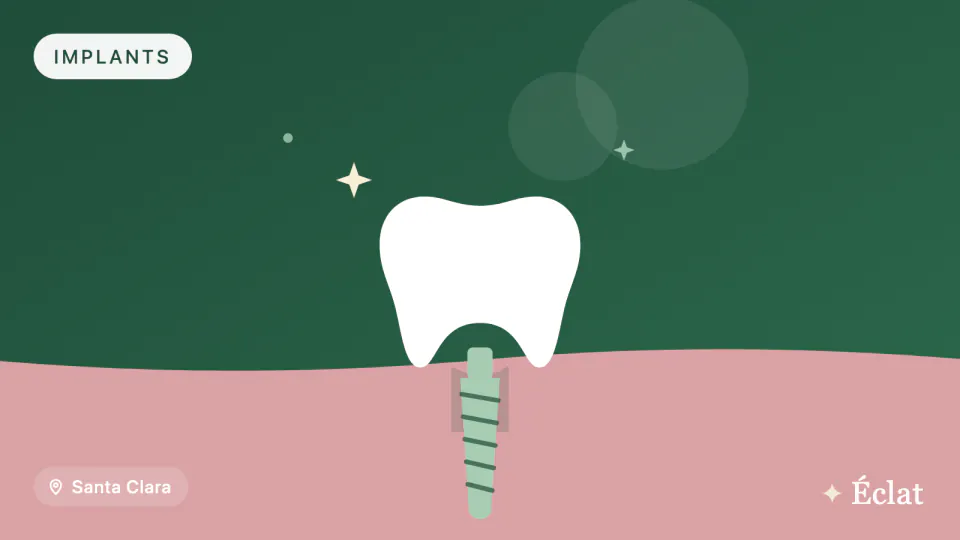
Dental Implants Near Santa Clara: From Consult to Crown
· Eclat Dental Studio
What a dental implant involves from first consult to final crown, how long it takes, and what recent research says about keeping implants healthy for the long term.
Opening soon: Eclat Dental Studio’s estimated grand opening is February 1, 2027.
In short: a single dental implant usually takes about three to nine months from first consultation to final crown, and longer if bone grafting is needed. Recent large reviews show implants can do well over time, but nearly half of implant patients develop some gum inflammation around an implant and about one in five develop the more serious bone-loss form. That is why planning, bone, gum health and maintenance all matter. This guide walks Santa Clara patients through each step. Timelines and protocols vary, including some one-stage or immediate approaches.
What happens at the consultation and planning visit?
The first visit is mostly about gathering information. A dentist will typically review your medical history, examine your gums and remaining teeth, and take images to check how much healthy bone is available. When it is recommended, 3D imaging such as CBCT can give a detailed view of bone height and width so the plan is based on what is really there rather than on a flat X-ray alone.
Candidacy usually comes down to a few things: enough healthy jawbone (or a plan to rebuild it), healthy gums, good daily cleaning habits, and well-managed health conditions such as diabetes. Smoking and vaping can interfere with healing, so dentists often raise them early. Many Santa Clara families, from Rivermark to the Old Quad, ask whether an implant is better than a bridge. The answer depends on the neighboring teeth, the bone and your goals, which is exactly what this visit sorts out. If you want to learn more about dental implant care, that page offers additional background.
What are the steps from surgery to crown?
Every case is different, and some patients have one-stage or immediate approaches, but a common two-stage sequence looks like this:
- Bone preparation, if needed. When the jaw is too thin or soft, a graft may be placed first. Grafts often need several months to mature, and sometimes up to a year.
- Implant placement. Under local numbing (sedation options may be discussed), the implant post is placed in the jawbone and, in a two-stage approach, the gum is closed over it. Initial recovery is typically about a week.
- Healing and bone bonding. The bone gradually fuses to the implant, a process called osseointegration. Most estimates run from roughly three to nine months, depending on bone quality and the individual patient.
- Abutment. Once the implant is stable, a small connector is attached, and the gums usually need at least a couple of weeks to settle around it.
- Final crown. Impressions or digital scans are used to make a crown that fits the abutment, and it is placed at a later visit. A temporary tooth is sometimes used in visible areas while you wait.
Because the stages are spread over months, you will typically have several short visits rather than one long one, and most follow-up visits are brief.
What does recent research say about long-term success?
A large 2025 systematic review published in a peer-reviewed periodontal journal combined 102 studies to look at how often implant patients develop problems in the tissue around an implant. It found that roughly 46 in 100 patients had peri-implant mucositis, which is inflammation limited to the gum tissue, and roughly 21 in 100 had peri-implantitis, which also involves bone loss around the implant. The numbers were counted per patient rather than per implant, which better reflects real life, since many people have more than one implant.
The same research looked at who is more likely to run into trouble. A history of gum disease, smoking and obesity were associated with the gum-inflammation form, while diabetes was associated with the bone-loss form. The authors also noted that studies define these conditions differently and that long-term data past ten years is still limited, so the exact percentages should be read as an estimate, not a guarantee.
There is encouraging news on the planning side too. Narrow-diameter implants, which can be an option when bone is thin and a standard-width implant would need extra grafting, have been studied in recent years, and studies report high short- to mid-term survival in selected cases. Those studies were not all uniform in how they measured outcomes, and the long-term picture is still maturing, so whether a narrow implant makes sense depends on your individual situation.
The takeaway is simple. An implant is not a set-and-forget treatment. It tends to succeed when the plan fits your bone, your gums are healthy before and after, and you keep up with maintenance.
How do you keep an implant healthy?
- Clean around the implant every day, including between the teeth and along the gumline.
- Keep regular checkups and cleanings. Patients with a history of gum disease, smoking or diabetes may be asked to come in more often.
- Report bleeding, swelling, pus, or a loose feeling right away, since early attention matters.
- Expect that the crown itself may eventually need replacing, even when the implant underneath is doing well. Crowns commonly last roughly 10-15 years, sometimes less.
Common questions about dental implants
Q: Does insurance cover implants?Coverage varies a lot by plan. Our team can verify your benefits and tell you whether we are in-network with your plan before treatment, and explain what your plan may cover. Investment depends on case complexity, whether grafting is needed, and the type of restoration, and you will receive a written estimate after your consultation. If you do not have insurance, ask about our membership plan, and ask our team about payment options.
Q: Is the implant procedure painful?Placement is done with local numbing, and many patients describe the recovery as manageable, with soreness and swelling for the first several days. A dentist will go over what to expect and how to manage it.
Q: How long do implants last?Many implants function for decades with good daily care and regular visits, but longevity varies and is not guaranteed. The crown on top usually wears out sooner and may need replacing.
Q: Can I get an implant if I have gum disease or diabetes?Sometimes, but the condition generally needs to be treated or well controlled first, and a closer maintenance schedule is common afterward. Whether an implant is appropriate depends on your own health and a dentist's evaluation.
Q: Is language assistance available?If you or a family member would be more comfortable discussing treatment in a language other than English, ask our team about language assistance options when you call to schedule.
If you are weighing an implant, a consultation is a low-pressure way to see what your bone and gums can support. We are serving patients in Santa Clara and nearby cities, and you can call (650) 917-8348 or visit eclatdentalstudio.com to schedule a visit.
This article is general education, not a diagnosis or treatment recommendation. Talk with a dentist about your own situation.