Dental Implants for Woodside Patients: A Clear Guide
· Eclat Dental Studio
How the dental implant process works from first exam to final crown, how long healing takes, and what Woodside patients should know before starting.
Opening soon: Eclat Dental Studio’s estimated grand opening is February 1, 2027.
A dental implant replaces a missing tooth root with a small post placed in the jawbone. Once the bone has fused to the post, a connector and a crown (or bridge or denture) are attached on top. The process usually takes several months, mostly because of healing time, and it starts with an exam and 3D imaging to check your bone and gums. Here is what that looks like, written for patients in Woodside and nearby communities.
This article is general education, not a diagnosis or personal medical advice. Talk with a dentist about your own situation.
What is a dental implant, exactly?
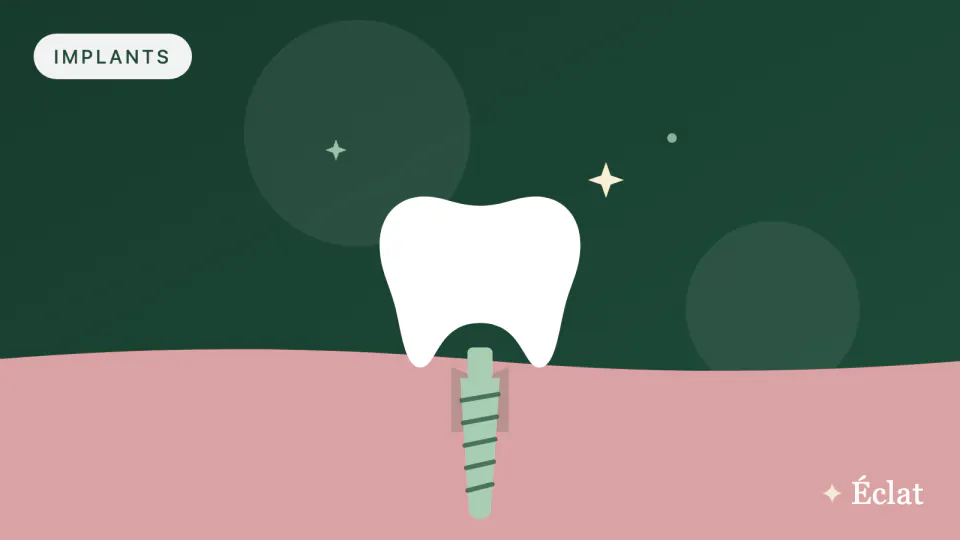
An implant has three parts. The first is a threaded post, usually titanium, that sits in the jawbone where the tooth root used to be. The second is an abutment, a small connector that attaches to the post and sits just above the gumline. The third is the visible restoration: a crown for one tooth, a bridge for several, or a denture for a full arch.
Implants can support a single tooth, a multi-tooth bridge, or a full set of teeth, which usually uses about four to six implants. Unlike a traditional bridge, a single implant does not require shaving down the healthy teeth on either side. Implants also help preserve the jawbone, which tends to shrink after a tooth is lost.
Who is a good candidate?
Dentists generally look for three things: good overall health, enough healthy jawbone to hold the post, and gums free of periodontal disease. Implants are typically placed in adults whose jaw growth is complete. Age alone is generally not a barrier; overall health matters more.
Several conditions call for extra care or treatment first:
- Active or untreated gum disease
- Poorly controlled diabetes
- Bone disorders, certain autoimmune conditions, or medications that affect healing
- Smoking or vaping, which can interfere with healing
These are not automatic disqualifiers. Many can be managed or treated before surgery, and a dentist will go over your history to decide what makes sense. Dentists typically use 3D (CBCT) imaging to evaluate bone height and width before planning an implant.
What are the steps, and how long does it take?
- Consultation and planning. Expect an exam, imaging, and a review of your medical history. If bone is thin, a bone graft, sinus augmentation (raising the sinus floor to build bone in the upper back jaw), or ridge modification may be needed first, which adds healing time.
- Implant placement. The surgery is done with local anesthesia, and sedation options may be available depending on the practice. The gum is opened, a small channel is prepared in the bone, the post is placed, and the gum is stitched closed. A temporary tooth may be used for a front tooth.
- Healing and bone fusion. Early recovery takes about a week, with mild soreness and swelling that over-the-counter pain relievers usually manage. The bone then fuses to the implant, a process called osseointegration, which commonly takes about three to nine months depending on the person.
- Abutment and final crown. Once healing is confirmed, the connector and restoration are attached. This visit often takes around an hour, though some cases need a minor second procedure to expose the post.
Because so much of the timeline is waiting, many visits are brief, though the number of appointments varies by case. Our Mountain View office is a short drive via I-280 for many Woodside-area residents, which can make the visits easier to plan around.
How do you care for an implant long term?
An implant cannot decay, but the gum and bone around it can still become inflamed. The first stage, peri-implant mucositis, affects only the soft tissue and is often reversible when caught early. If it progresses to peri-implantitis, bone around the implant begins to break down, and treatment may range from non-surgical cleaning to surgery, depending on severity. Risk factors include a history of gum disease, poor plaque control, smoking, and diabetes.
The routine is simple: brush and floss daily, and keep regular checkups so the implant, teeth, and gums can be monitored. With good care, implants can last many years, often decades, though results vary and no outcome is guaranteed. The crown or bridge on top may eventually need replacing, sometimes after 15 years or so, but this varies from person to person. If you would like to learn more about dental implant care, that page has more on implant treatment and what to expect.
Cost depends on the number of implants, whether grafting is needed, and the type of restoration, so it is worth asking about a written estimate after your consultation instead of relying on a one-size number. Our office accepts all PPO dental plans and is in-network with Delta Dental. Woodside is in San Mateo County, and some families ask about Health Plan of San Mateo (HPSM); our office accepts HPSM, though coverage for implant treatment may be limited, so it is worth asking us to check your specific benefits. Our team speaks English, Mandarin, Cantonese, and Spanish, and can talk through payment options with you.
Common questions about dental implants
Q: Is implant surgery painful?The area is numbed with local anesthesia, so most people feel pressure rather than pain during the procedure. Soreness and swelling afterward are normal and usually settle within about a week.
Q: Do I need a bone graft?Only if there is not enough jawbone to support the post. Imaging at the consultation shows whether grafting, a sinus augmentation, or ridge modification would be recommended.
Q: Can I have an implant if I smoke or have diabetes?Sometimes, but both raise the risk of healing problems and gum disease around the implant. Dentists often recommend quitting smoking and keeping blood sugar well controlled before treatment. Your own situation may differ, so talk with a dentist about it.
Q: How long until I have a finished tooth?Plan on several months. Bone fusion alone commonly takes about three to nine months, and any grafting would add time.
Start with a conversation
If you are in Woodside or the surrounding area and wondering whether implants are right for you, a consultation is a no-pressure way to find out. Call (650) 917-8348 or visit eclatdentalstudio.com to schedule. We serve patients in Woodside, Menlo Park, Redwood City, and nearby cities from 530 Showers Drive, Suite 3, in Mountain View.