Dentures vs. Dental Implants: A Sunnyvale Guide to Missing Teeth
· Eclat Dental Studio
Dentures or dental implants? Compare comfort, chewing, jawbone health, upkeep, risks, and who makes a good candidate, with a guide for Sunnyvale patients.
Opening soon: Eclat Dental Studio’s estimated grand opening is February 1, 2027.
Dentures are removable, non-surgical, and often the quicker way to replace missing teeth. Dental implants are anchored in the jawbone, which generally gives more stability and helps slow bone loss in the area around the implant, but they need surgery, healing time, and healthy gums. A middle option, the implant-retained denture, combines both. A dentist can tell you which fits you after an exam and, where appropriate, 3D imaging.
How do dentures and dental implants actually differ?
A conventional denture rests on the gums and is held in place by fit, suction, and sometimes adhesive. Dentists usually place a conventional set after the remaining teeth are removed and the tissue has healed, which can take several weeks to a few months, depending on the case. An immediate denture goes in on the day of extraction. It often needs relining or remaking later, once the jaw has settled into its new shape.
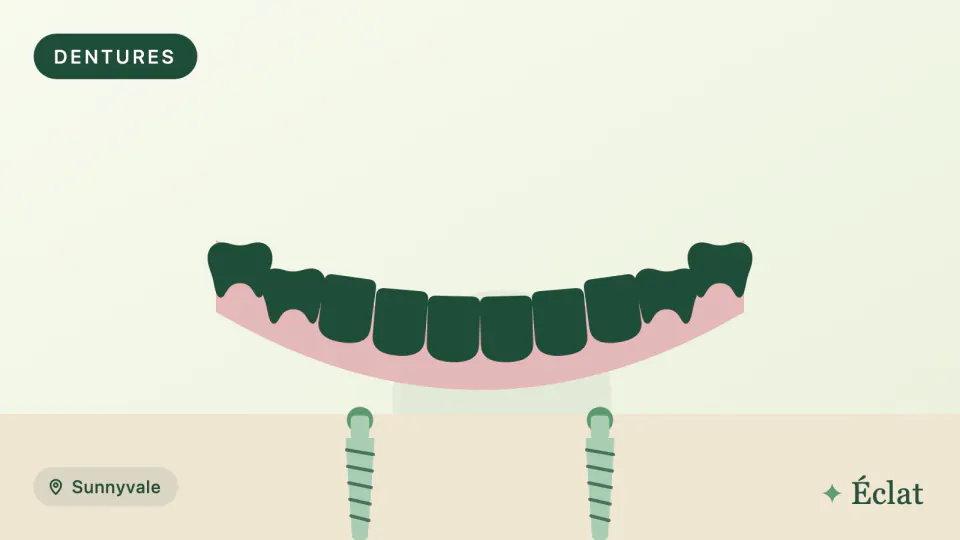
An implant is a small post placed in the jawbone that acts as an artificial root. A crown, bridge, or denture then attaches to it. Because the post sits in bone rather than on the gums, an implant-supported restoration feels more like part of the mouth. The tradeoff is a surgical step and a healing period before the final teeth are placed.
The in-between option: implant-retained dentures
An overdenture snaps onto a small number of implants. It is still removable, but it holds firmly. For people missing most or all of their lower teeth, this is a common compromise between a conventional denture and a full set of individual implants.
What does the research say about chewing, comfort, and bone?
Studies that compared implant-retained dentures with conventional dentures mostly found improvements in bite force and chewing ability. Patients also reported high satisfaction with comfort. The evidence has limits. Many studies are small, they measure outcomes in different ways, and most focus on the lower jaw. Better chewing does not always translate into a higher overall quality of life.
Bone is the other big difference. After teeth are lost, the ridge that supported them gradually shrinks, and a denture resting on top does little to stop that. Studies of implant-retained overdentures generally report small amounts of bone change around the implants, most of it in the first year, and slower change after that. Individual results vary. Bone changes still happen elsewhere in the mouth. Even implant-retained dentures need periodic relining, and the small attachments that hold them can wear and need replacing.
Day-to-day life with dentures
New dentures often feel awkward or loose for a few weeks while your cheeks and tongue adapt. Mild soreness and extra saliva are common early on, and persistent irritation should be checked. Dentures need daily cleaning with a soft brush and a non-abrasive cleanser, plus gentle brushing of the gums, tongue, and palate. They should be kept in water when they are out of the mouth so they do not warp. Regular checkups let a dentist monitor the fit as your jaw changes.
Risks to understand with implants
Implants carry risks, including infection, peri-implantitis (inflammation around the implant), implant failure, and the need for lifelong cleaning and follow-up. Bone grafting or sinus procedures, when needed, can add time and cost to treatment. A dentist can review these risks for your situation.
Who is a good candidate for dental implants?
Implants depend on healthy bone and gums, so candidacy is decided case by case. Several factors come up repeatedly in the research:
- Smoking: Reviews consistently link smoking to higher implant failure and more inflammation around the implant. Stopping before and during healing improves the odds.
- Gum disease: Active gum disease is usually treated first. Good oral hygiene and periodontal care support implant success.
- Diabetes: Well-controlled diabetes generally shows survival comparable to people without it. Poorly controlled blood sugar has been tied to more inflammation around implants.
- Bone quantity and quality: 3D imaging may be used to evaluate how much bone is available. Some patients need additional steps before an implant can be placed.
Implants are not limited to younger adults. Research suggests age alone is not a barrier; overall health and jaw condition matter more.
Which option fits a Sunnyvale household?
Common questions people ask are about timeline, upkeep, and budget. For example, someone may want to avoid surgery. Another person may care most about how natural the result looks and feels. A third may be weighing a lower-jaw overdenture against full dentures. All of these are reasonable starting points.
A few questions help clarify the choice:
- How many teeth are missing, and where?
- Is there enough healthy bone and gum tissue to support implants?
- Are you comfortable with a surgical step and a longer timeline?
- How important are stability and a firm bite compared with simplicity and lower upfront investment?
Cost varies with the number of teeth, the type of restoration, whether bone support is needed, and lab fees, so this guide does not list figures. Ask the office about estimates, insurance, and payment options when you schedule a consultation.
Many people also have routine needs alongside tooth replacement. Healthy gums and teeth support either option, so general and family dentistry is often part of the overall plan.
Common questions about dentures vs. implants
Q: Do I have to choose all implants or all dentures?No. Many people choose an implant-retained denture, which uses a few implants to steady a removable set. A dentist can walk you through the options for the upper and lower jaw separately.
Q: Will dentures stop fitting over time?They can. The jaw changes shape after teeth are lost, and this is why dentures sometimes need relining, adjusting, or replacing. Regular checkups help catch fit problems early.
Q: Is it too late for implants if I have had dentures for years?Not necessarily. Years of wearing dentures can reduce the bone available, but 3D imaging may help show what you have to work with. Some patients need extra steps first, and some are better served by a different option.
Q: Is one option better for Sunnyvale patients who commute or travel?Neither is tied to location. If your schedule is tight, ask about the number of visits and the healing timeline for each approach so you can plan around work and travel.
Take the next step
If you are weighing dentures against implants, a consultation can give you a clear picture of your options based on your own mouth, not a generic guide. Serving patients in Sunnyvale and nearby cities, Eclat Dental Studio is happy to answer questions with no pressure. Call (650) 917-8348 or visit eclatdentalstudio.com to schedule a visit.