Full-Arch Implants Near Cupertino: Is a Fixed Bridge for You?
· Eclat Dental Studio
Considering a fixed implant bridge? Research suggests the prosthesis material and your daily habits can shape results as much as surgery day. Here's what the evidence points to, and where it is still limited.
Opening soon: Eclat Dental Studio’s estimated grand opening is February 1, 2027.
A fixed full-arch implant bridge can be an option for many people who are missing most or all of their teeth in one jaw, but the outcome depends on more than the surgery itself. Research suggests that bridges with a metal framework and zirconia teeth may show less wear than metal-and-acrylic versions. Long-term research on smoking and home care also suggests daily habits matter. The sections below explain what that means, in plain language, and what it does not yet prove. This article is general education, not individual dental advice; talk with a licensed dentist about your situation.
What is a fixed full-arch implant bridge?
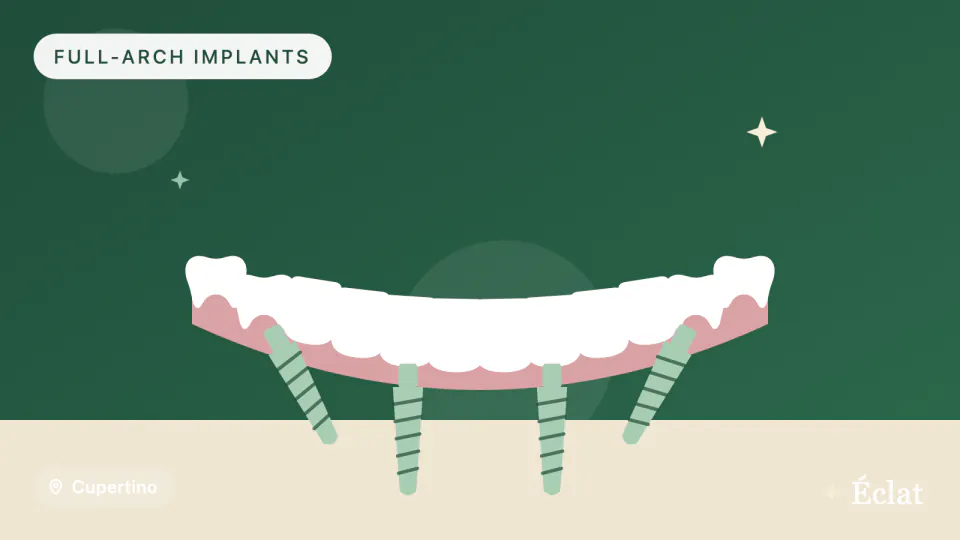
A full-arch implant bridge is a complete set of replacement teeth held in place by a handful of dental implants, which are small titanium posts placed in the jawbone. The bridge is screwed onto the implants, so it does not come out for daily cleaning the way a removable denture does. Dentists often consider it for people with failing teeth, advanced gum disease, or dentures that never feel stable.
Not everyone is a candidate. A dentist will typically look at bone volume, gum health, bite forces, and overall health before recommending it. A dentist may use 3D (CBCT) imaging to evaluate your bone in three dimensions instead of relying only on a flat X-ray. If you are weighing your choices, our full-arch implant options page walks through how the approach works.
Does the bridge material really make a difference?
Screw-retained bridges are commonly built in one of two ways. One uses a metal framework covered in acrylic, with denture-style teeth. The other uses a metal framework with zirconia, a very hard ceramic, for the teeth. Researchers have compared the two designs in clinical studies that followed patients over time.
- Wear: Research suggests metal-zirconia bridges may show less wear than metal-acrylic bridges.
- Gum-related problems: Peri-implantitis, an infection of the tissue and bone around an implant, has also been reported somewhat less often with zirconia in some studies. The difference was small, so it is a possible trend rather than a guarantee.
- Other mechanical problems: Chipping, loose screws, and framework fractures have more often been reported with metal-acrylic bridges, though results vary between studies.
Zirconia bridges have tended to last longer as prostheses in some comparisons, while the implants themselves appeared to survive at similar rates either way. Zirconia typically costs more up front, and how that balances out over the years can differ from person to person.
What the evidence does not show yet
Much of this research is observational rather than randomized trials, and follow-up was short in some studies. That means the data are still maturing for the 10-to-20-year picture. Patients and dentists were not assigned to materials by chance, so other differences between groups may play a role. Treat this as a helpful early signal for the conversation with your dentist, not a rule that one material is right for everyone.
How much do smoking and daily habits matter?
Implants themselves usually do well. In many full-arch studies that follow patients for roughly five to ten years, survival of individual implants is generally high. Where outcomes differ is in the details, and tobacco is one of the most consistent themes.
Research on smokers with full-arch implants is mixed. Some studies found more bone loss around the implants and more peri-implantitis in smokers. Others found no clear difference in whether the implants survived over several years. A reasonable reading is that smoking may not make implants fail overnight, but it can make the tissue around them harder to keep healthy. Dentists commonly encourage patients to cut back or quit before and after treatment, since that may improve healing.
Cleaning matters just as much. A fixed bridge sits over the gums, and plaque that builds up underneath is a main driver of peri-implantitis. Most dentists recommend:
- Brushing the bridge and gum line twice a day
- Cleaning under the bridge daily with the tools your dental team shows you
- Regular professional maintenance visits, so small problems are caught early
- A night guard if you clench or grind, when your dentist advises one
Risks and long-term maintenance
Full-arch treatment is a surgical procedure, and it carries risks like any surgery, including infection, bleeding, swelling, and nerve or sinus complications in some cases. Not every implant integrates with the bone, and an implant can fail early or years later. The bridge itself may need repairs, screw tightening, or eventual replacement as it wears. Removing teeth cannot be undone, so it is worth understanding alternatives, such as other restorations or removable options, before deciding. Outcomes vary from person to person, and a licensed dentist can explain the risks that apply to you.
Planning a consult from Cupertino
If you are comparing treatment options for yourself or for a parent or grandparent, the first question is often about time and logistics. Our Mountain View office is a short drive from Cupertino, and travel time varies with traffic. That can be useful to plan around, since full-arch care involves several visits.
Bring a list of your medications, your medical history, and any recent dental X-rays. At a consultation, a dentist will usually review your imaging, talk through bridge material options, and explain what daily care would look like for you. Investment varies with case complexity, the number of implants, and the materials chosen. Ask about a written estimate after your exam. Our office accepts all PPO dental plans and is in-network with Delta Dental, and uninsured patients can ask about our membership plan. Our team speaks English, Mandarin, Cantonese, and Spanish.
Common questions about full-arch implant bridges
Q: Can I keep my existing teeth if I choose a full-arch bridge?Usually the teeth in that arch are removed if they are failing or cannot be saved, because the bridge replaces the whole arch. A dentist can tell you which teeth, if any, are worth keeping.
Q: Is zirconia always better than acrylic?Not necessarily. Current research points toward less wear and fewer some complications with zirconia, but the studies are mostly observational and the follow-up is still limited. The right material depends on your bite, your budget, and your dentist's assessment.
Q: Will I be able to get implants if I smoke?Many smokers do receive implants, but the research suggests a higher risk of bone loss and gum problems around them. A dentist will usually discuss your habits openly and may recommend quitting or cutting back before treatment.
Q: Do I still need dental visits after the bridge is placed?Yes. Regular maintenance visits let your team check the screws, the bite, and the tissue around each implant before small issues grow.
Take the next step
If you are in Cupertino or a nearby city and wondering whether a fixed implant bridge fits your situation, a consultation lets you ask questions and learn about options. Call (650) 917-8348 or visit eclatdentalstudio.com to schedule a visit at 530 Showers Drive, Suite 3, in Mountain View, where we see patients from Cupertino and across the Peninsula.