Full-Arch Implants for Los Altos Hills Patients: Planning Ahead
· Eclat Dental Studio
Planning full-arch implants in Los Altos Hills? See what research says about bridge materials, why daily habits like smoking matter, and what to ask at a consult.
Opening soon: Eclat Dental Studio’s estimated grand opening is February 1, 2027.
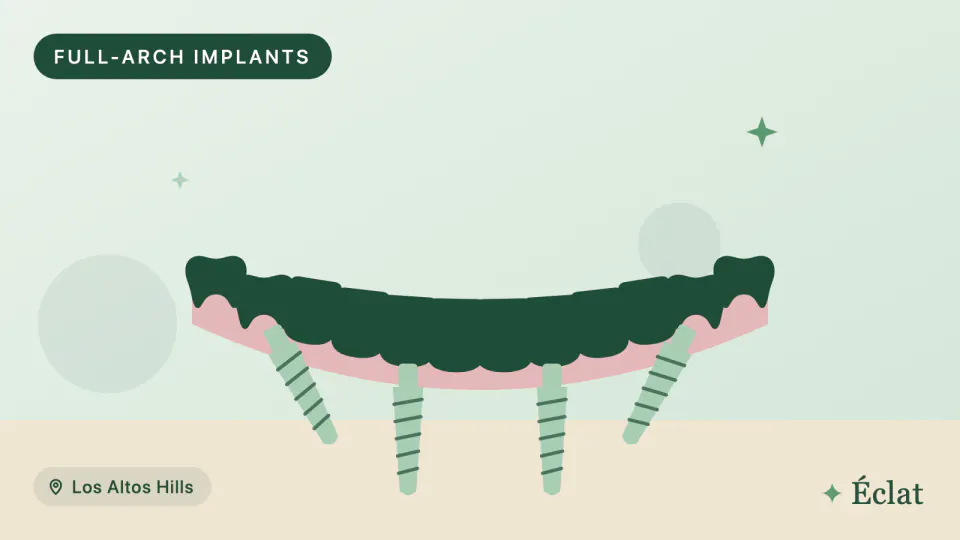
A full-arch implant bridge replaces a whole row of teeth with a fixed set of teeth anchored on several implants. Research suggests that the bridge material and your daily habits can shape how well it holds up, alongside the surgery itself. Some published research has compared zirconia and acrylic full-arch bridges, with mixed findings on wear and gum health, and smoking is generally associated with higher implant complication rates. If you are a Los Altos Hills patient planning a new smile, it helps to talk through material, maintenance, and habits before surgery day.
This article is general education, not individual medical advice. Candidacy and treatment depend on an in-person evaluation.
What does research say about bridge material?
Many full-arch bridges are screw-retained, meaning the bridge is held to the implants with small screws. Designs vary, though, and some are cement-retained. With a screw-retained design, a dentist can usually remove the bridge for cleaning or repair. The two common designs use a metal framework topped with either zirconia (a strong ceramic) or acrylic teeth.
Some published research has compared zirconia and acrylic full-arch bridges, with mixed findings on wear and gum health. Some studies report less wear with zirconia, while others find no difference in peri-implantitis (inflammation and infection around an implant) or in implant failure.
What the evidence does not show yet
- Findings are mixed, so it is hard to say that the material alone causes any difference in wear or gum health.
- Some studies have found no meaningful difference in implant survival or peri-implantitis between the two designs, and a small trial raised the possibility of more bone loss with certain zirconia designs. Both materials can work well.
- Cost and lab work vary by material, and the right choice depends on your mouth, your bite, and your priorities.
In plain terms, the evidence is mixed, and material choice is individualized. Long-term evidence is still maturing, and it is early to call any one material the answer for everyone.
Do daily habits matter as much as the surgery?
Research suggests they matter a great deal. Full-arch bridges can be more prone to mechanical and technical complications than smaller implant restorations. Poorly positioned implants and excess biting force are two of the contributors discussed in the literature.
Research generally associates smoking with higher implant complication rates. Other research on implant bridges has linked a history of gum disease and teeth grinding with more mechanical complications. Individual risk varies from person to person, and a dentist can assess yours.
Dentists often discuss these points before treatment:
- Stopping or reducing tobacco use, ideally well before and after surgery.
- Protecting the bridge from clenching and grinding, sometimes with a night guard.
- Cleaning under and around the bridge every day with the tools your dental team recommends.
- Keeping regular maintenance visits so small problems, such as a loose screw or early gum inflammation, are caught early.
What does planning look like for Los Altos Hills patients?
A good plan starts with a detailed look at your health history, your gums, and your bone. During the consult, a dentist can assess bone volume and anatomy. From there, the conversation usually covers bridge material, the number of implants, your bite, and a realistic maintenance routine.
People often ask how many visits to expect and how to care for the bridge afterward. These are good questions to bring to your consultation.
If you are weighing your choices, our page on full-arch implant options outlines how the process works. Investment varies with case complexity, materials, and lab work, so we provide a written estimate after your consultation. Ask our team about payment options. We accept all PPO dental plans and are in-network with Delta Dental, and our team speaks English, Mandarin, Cantonese, and Spanish.
Common questions about full-arch implants
Q: Is a zirconia bridge always better than an acrylic one?Not always. The evidence is mixed: some studies report less wear with zirconia, while others find no difference in peri-implantitis or implant failure. Material choice is individualized, and a dentist will weigh your bite, your habits, and your goals when recommending one.
Q: Do I have to quit smoking to get full-arch implants?Whether you are a candidate for full-arch implants is decided by a dentist after an in-person evaluation. Research generally associates smoking with higher implant complication rates, so it is worth discussing a plan well before surgery.
Q: How long will a full-arch bridge last?There is no single number that fits everyone. Long-term data are still maturing, and outcomes depend on material, bite forces, home care, and regular maintenance visits.
Q: Will I need maintenance after my bridge is placed?Yes. Even well-made bridges need periodic checks and professional cleaning. Wear, screw loosening, and gum inflammation are among the issues that routine visits are meant to catch early.
If you live in Los Altos Hills or a nearby city and want to talk through a full-arch plan, we welcome you to schedule a consultation. Call (650) 917-8348 or visit eclatdentalstudio.com. Our office is at 530 Showers Drive, Suite 3, Mountain View, and we serve patients in Los Altos Hills, Los Altos, Palo Alto, and surrounding communities.