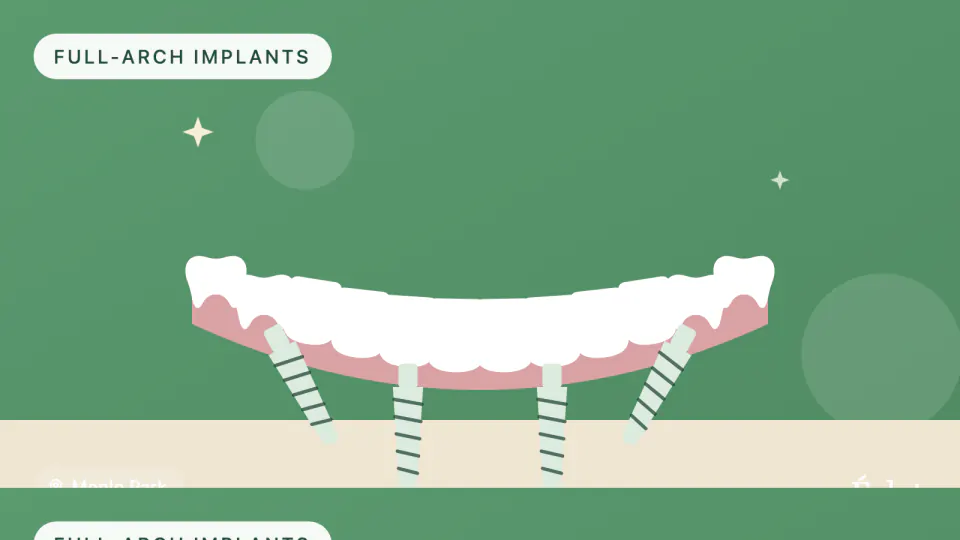
Full-Arch Implants for Menlo Park Patients: A Fixed Alternative to Removable Dentures
· Eclat Dental Studio
Considering a fixed alternative to removable dentures? See what recent research says about bridge materials, daily habits, risks, and long-term upkeep, and what to expect as a Menlo Park patient.
Opening soon: Eclat Dental Studio’s estimated grand opening is February 1, 2027.
Full-arch implants replace a whole row of missing or failing teeth with a fixed bridge anchored to a handful of implants. Recent research suggests that long-term success depends on more than surgery day: the material the bridge is made from and the daily habits you keep afterward both matter. For Menlo Park patients comparing this option with traditional dentures, the evidence is encouraging, though it is still maturing. This article is general education and not a substitute for an exam; candidacy and treatment depend on an individual evaluation by a licensed dentist.
How are full-arch implants different from dentures?
A conventional denture rests on the gums and can shift when you eat or speak. A full-arch implant bridge is screwed onto implants placed in the jaw, so it is designed to stay in place and can offer more chewing stability than a removable appliance. Because the implants sit in bone, they can also help preserve bone stimulation compared with a removable appliance, although bone preservation around implants is not guaranteed. Keep in mind that a fixed full-arch prosthesis is sometimes called a fixed or hybrid denture, so the terminology can vary from one clinician to another.
Fixed does not mean maintenance-free. Common questions patients ask usually start with 'Will this last?' and 'What will I have to do afterward?' The honest answer to both depends heavily on two choices: the bridge material and your routine at home.
Does the bridge material really matter?
Traditionally, many full-arch bridges have been built on a metal framework with acrylic (a type of dental plastic) for the teeth and gum-colored portion. Newer designs use zirconia, a strong ceramic. Reviews of clinical studies note that acrylic tends to wear down, chip, and sometimes fracture over time, and its slightly porous surface may hold on to plaque more easily. In published long-term comparisons of patients treated with each type, zirconia bridges tended to have fewer complications and a higher bridge survival rate than metal-acrylic ones, though these comparisons are largely retrospective. Solid (monolithic) zirconia also appears to chip less than zirconia layered with porcelain.
It is important to keep this in perspective. No material is free of problems, and zirconia can fracture, particularly at thinner connecting areas. Many of the studies are retrospective, follow patients for different lengths of time, and use different designs, which makes them hard to combine into one firm conclusion. A fair summary is that zirconia looks promising for durability and cleanability, while the data are still maturing. A dentist will typically weigh your bite, your jaw anatomy, any grinding habits, and your goals before recommending a material.
How much do daily habits affect the result?
Quite a lot. Implant survival in recent full-arch research is generally reported as high over the long term. Even so, studies report that minor mechanical and soft-tissue complications are fairly common over time even when implant survival is high. Most of these issues are manageable, which is a strong argument for staying on top of upkeep.
- Cleaning: Dentists commonly recommend daily brushing, flossing around the bridge, and a water flosser to reach the underside.
- Maintenance visits: Many dentists suggest checkups every few months in the first year, then at least every six months, with periodic X-rays and 3D imaging to check bone and screws. Maintenance protocols vary by prosthesis design and clinician.
- Bite checks: Loose screws or uneven biting forces can stress the bridge, so the bite is typically re-evaluated at each visit.
- Smoking: Some studies have found more bone loss around implants in smokers, even when survival rates were not always significantly different. Research on this is mixed, but quitting or cutting back is generally considered worthwhile.
In many cases, bridges can be cleaned professionally while they stay in place, depending on the design. A dentist may remove the bridge for a deeper cleaning only when something calls for it, such as inflamed tissue.
What are the risks, and who is a candidate?
Like any surgical procedure, full-arch implant treatment carries risks, including infection, implant failure, and peri-implantitis (inflammation and bone loss around an implant). Some patients need bone grafting before or during treatment if there is not enough bone to support implants. Certain conditions, such as uncontrolled diabetes, inadequate bone volume, or heavy tobacco use, can limit candidacy or raise the risk of complications. Whether full-arch implants are appropriate for you can only be determined through an individual evaluation by a licensed dentist, who can also discuss alternatives.
What should Menlo Park patients expect from planning and logistics?
Planning typically starts with 3D (CBCT) imaging to assess bone volume and where implants can be placed; ask our team how and where this is arranged. If you want to see what your options look like, our overview of full-arch implant options explains the general process in more detail.
We welcome patients from Menlo Park and surrounding communities. Our office at 530 Showers Drive, Suite 3 in Mountain View is a short drive from Menlo Park, depending on traffic, which helps when a treatment involves several visits.
The investment varies with case complexity, the bridge material, and how much preparation your jaw needs, so we provide a written estimate after your consultation instead of quoting a generic number. We accept all PPO dental plans and are in-network with Delta Dental. Because Menlo Park is in San Mateo County, some patients also ask about Health Plan of San Mateo (HPSM). Coverage varies by plan, and our team can help you check what applies to you. If you do not have insurance, ask about our membership plan and payment options. Our team speaks English, Mandarin, Cantonese, and Spanish.
Common questions about full-arch implants
Q: Are full-arch implants permanent?The implants are intended to last for many years, but results and longevity vary by patient. The bridge itself can wear and may need repairs or replacement parts over time. That is why scheduled maintenance matters as much as the original procedure.
Q: Does smoking affect implants?Research suggests smoking is associated with a higher risk of bone loss around implants and with more complications. Whether implants are appropriate for a smoker is an individual decision, and a dentist will usually discuss this openly and may encourage reducing or stopping smoking before and after treatment.
Q: Do I take the bridge out to clean it?Generally no. Daily cleaning happens with the bridge in place, and professional cleanings are often done the same way, though this depends on the prosthesis design. Occasional removal by a dentist is reserved for specific concerns.
Q: Is zirconia always better than acrylic?Not always. Zirconia shows promising durability, but the right choice depends on your bite, your jaw, and your goals. The long-term data are still being collected.
If you are in Menlo Park or a nearby city and wondering whether a fixed alternative to removable dentures is right for you, we would be glad to talk it through. Call (650) 917-8348 or visit eclatdentalstudio.com to schedule a no-pressure consultation.