Receding Gums Sunnyvale: Grafts, Collagen Matrix, Prevention
· Eclat Dental Studio
Gum recession doesn't reverse on its own, but grafting is a well-studied option and collagen matrix is a promising alternative. Learn how early evaluation can widen your options.
Opening soon: Eclat Dental Studio’s estimated grand opening is February 1, 2027.
Receding gums do not grow back on their own, but they can often be treated, and the earlier recession is caught, the more options you tend to have. Systematic reviews of randomized trials suggest root coverage surgery can improve both clinician-rated and patient-reported esthetic outcomes. A collagen matrix can be an alternative to tissue taken from the roof of your mouth in suitable cases, though the evidence for matrices is still maturing.
This article is general education and not a substitute for an exam; only a dentist can diagnose recession and recommend treatment for you.
What causes gums to recede, and why does early detection matter?
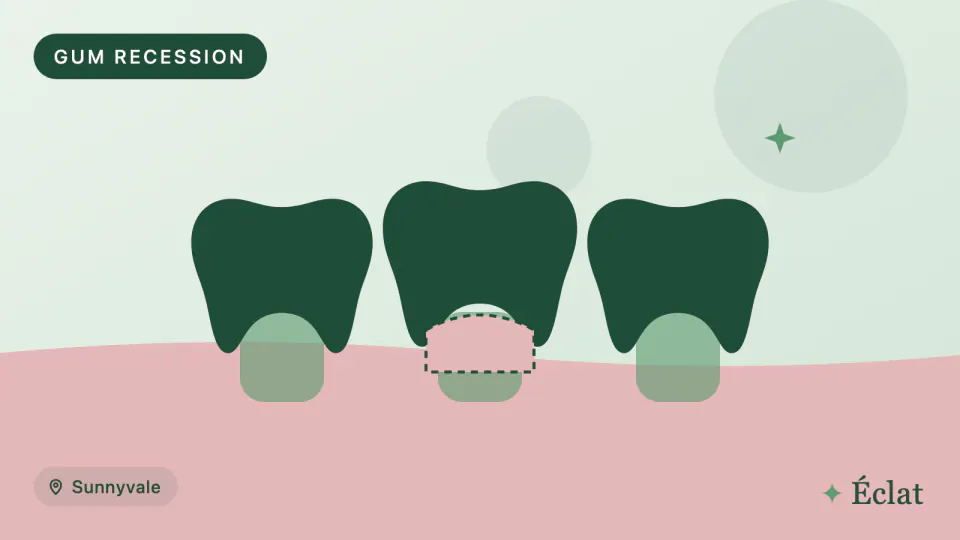
Gum recession happens when the gum edge moves away from the crown of the tooth and exposes the root. Patients often first notice sensitivity to cold air or drinks, a tooth that looks longer, or a notch near the gumline. Common contributors include overly forceful brushing, gum infection, tobacco use, clenching or grinding, orthodontic tooth movement, lip or tongue piercings, and naturally thin gum tissue. Many people have brushed hard for years with good intentions and never realized it was affecting their gums.
Early detection matters because the shape of the problem changes the options. Research suggests that grafting results are most predictable when the recession is still shallow and the bone and tissue between the teeth are intact. Once the tissue between teeth is lost, complete coverage becomes much less likely in many cases. If recession is tied to active gum infection, gum disease treatment usually has to come first, because grafting onto inflamed tissue is generally not considered a sound plan.
What does recent research say about gum grafting?
Systematic reviews of randomized trials suggest that root coverage surgery can improve esthetic outcomes as judged by clinicians and as reported by patients. Techniques that lift the gum and slide it back over the root, either with a coronally advanced flap or a small tunnel under the gum, have performed well in studies when paired with a graft or graft substitute.
Across the wider literature, reported root coverage varies widely by case, technique and defect type, and complete coverage of every exposed root surface is less common than partial coverage. Treat any single percentage as an average, not a promise for your teeth.
Collagen matrix versus your own tissue
Many periodontists describe a connective tissue graft, taken from the palate, as the long-standing reference approach. A collagen matrix is a processed, sterile material that serves as scaffolding so your own gum tissue can thicken. In some analyses, mainly for shallow recessions, overall root coverage with a matrix did not differ significantly from a graft of your own tissue. A matrix may shorten surgery time and can avoid a palate donor site.
The picture is not one-sided, though. In several analyses, your own tissue still produced more gain in the band of firm, attached gum and a greater reduction in recession depth, and the literature generally still leans toward it for more complex cases. Pain findings were mixed. Some trials found less early discomfort with the matrix, others did not. Most trials followed patients for 6 to 12 months, so long-term stability of matrix results is still being studied. In short, a matrix may be considered in some milder cases, for patients who want to avoid a palate donor site, or for those without enough palate tissue, but it is not automatically equivalent in every situation.
How can you prevent more recession?
- Brush gently: a soft brush, light pressure, and short strokes along the gumline. Many people find an electric brush with a pressure sensor helpful.
- Keep gum disease under control: regular cleanings and daily flossing protect the bone and tissue that hold the gum in place.
- Address grinding or clenching: dentists often recommend a custom night guard when wear or bite stress is suspected.
- Avoid tobacco: it impairs healing and is linked to gum breakdown.
- Get early checks: asking a dentist to measure and photograph a suspicious spot lets you track whether it is stable or progressing.
Not every recession needs surgery. A stable, shallow area with no sensitivity is often simply monitored, while recession that is progressing, causing sensitivity, or sitting on thin gum is something a dentist may discuss grafting for. Whether monitoring or treatment makes sense depends on an exam of your own mouth.
What to expect when you come in from Sunnyvale
We welcome patients from Sunnyvale and nearby cities. A consultation visit for gum concerns may include a gum and bite exam, measurements of the recession, and a review of your brushing habits, followed by a discussion of whether monitoring or a treatment option makes sense. Our team speaks English, Mandarin, Cantonese, and Spanish.
Cost varies with how many teeth are involved and how complex the case is, so ask about treatment options and costs during your visit. We accept all PPO dental plans and are in-network with Delta Dental. If you do not have insurance, ask about our membership plan and about ways to manage cost.
Common questions about gum recession treatment
Q: Can receding gums grow back?Not by themselves. Better habits and treating gum disease can help slow or prevent further loss, but regaining lost gum height generally requires a grafting procedure.
Q: Is a collagen matrix as good as a graft from my palate?Some studies suggest similar root coverage overall, particularly for shallow recessions, with possibly less surgery time and no palate donor site. Your own tissue may give more gain in firm gum, though, and long-term data on matrices is still limited. A dentist can tell you which fits your case.
Q: Will gum grafting hurt?The area is numbed during treatment, and many patients manage recovery with over-the-counter pain relief and a soft-food diet for a short period. Discomfort is often greater at a palate donor site. Recovery varies from person to person, and a dentist will advise you on post-operative care.
Q: Will whitening toothpaste or hard brushing make recession worse?Hard brushing can. Abrasive pastes used with firm pressure may add wear, so a gentle technique matters more than the product.
If you have noticed sensitivity or a tooth that looks longer, a short exam can show whether you need treatment or just monitoring. Serving patients in Sunnyvale and nearby cities, we welcome you to call (650) 917-8348 or visit eclatdentalstudio.com to schedule a consultation.