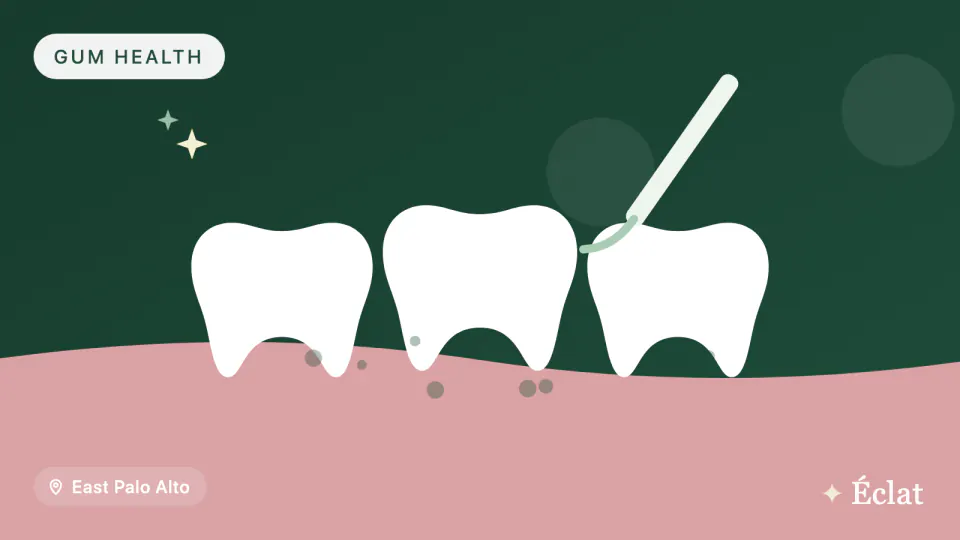
Bleeding Gums? Deep Cleanings With HPSM in East Palo Alto
· Eclat Dental Studio
Bleeding gums can signal gum disease. Learn how a regular cleaning differs from scaling and root planing, and how HPSM members in East Palo Alto can ask about gum treatment.
Gums that bleed when you brush or floss are often an early sign of gum disease, and they are worth having checked. A regular cleaning is enough for mild gum inflammation, while deeper pockets around the teeth usually call for scaling and root planing, often called a deep cleaning. HPSM members in East Palo Alto can ask about gum care as part of Medi-Cal dental benefits, and our office can help you confirm what applies to you.
What are the signs of gum disease?
Healthy gums are firm, pink, and don't bleed easily. Gum disease usually starts quietly, and many people don't feel pain until it has progressed. Common signs include:
- Gums that bleed during brushing or flossing
- Red, swollen, or tender gums
- Persistent bad breath or a bad taste
- Gums that seem to pull away from the teeth
- Teeth that feel loose or a bite that feels different
The mildest stage is gingivitis, which is inflammation caused by plaque along the gumline. It can often be reversed with good daily brushing, flossing, and professional cleanings. If it is left alone, it can progress to periodontitis. In periodontitis the gums pull away from the teeth and form pockets where plaque and tartar collect, and over time this can damage the supporting bone and lead to tooth loss.
How is a deep cleaning different from a regular cleaning?
A regular cleaning (prophylaxis) removes plaque and tartar from the visible parts of the teeth and just beneath the gumline. It is designed for people whose gums and bone are still healthy, or who have mild gingivitis.
Scaling and root planing treats gum disease that has already created pockets. It has two parts:
- Scaling removes plaque and hardened tartar from the tooth surfaces, including below the gumline and down into the pockets.
- Root planing smooths the root surfaces so bacteria have a harder time clinging and the gums can reattach more snugly.
Dentists generally check for this by measuring pocket depths with a small probe and reviewing X-rays for bone changes. Pockets deeper than about 4 mm may point to periodontitis, and deeper pockets are difficult to clean well with routine care alone. Treatment is often done with hand instruments, ultrasonic devices, or sometimes a laser. It may take more than one visit, and a local anesthetic is commonly used for comfort. Afterward, dentists typically schedule follow-up visits to see how the gums have healed and to set up a maintenance routine.
How can HPSM members in East Palo Alto get gum treatment?
HPSM is San Mateo County's Medi-Cal plan, so it applies to county residents, including those in East Palo Alto. Our office provides Medi-Cal dental care through HPSM as an HPSM-partnered provider, and members can often use their single HPSM member card at the visit. Preventive care such as exams, cleanings, and X-rays, along with restorative treatment and emergency care for pain or injury, is generally part of the dental benefit.
Which gum treatments are covered, and how often, can vary. HPSM reviews medically necessary dental treatment, so a deep cleaning may be covered when it is needed, but limits and requirements differ. Before your visit, we suggest you:
- Call our office at (650) 917-8348 to confirm availability and that your HPSM dental benefit is active.
- Ask the HPSM Dental Unit at 650-616-1522, or check your member materials, about coverage for scaling and root planing.
- Bring your HPSM member card, a photo ID, and a list of your medications and health conditions.
We hear from many East Palo Alto families, from University Village to the Gardens and the Ravenswood / Four Corners area, who are unsure whether bleeding gums are a big deal or whether coverage will help. The short answer is that an exam is the way to find out, and early treatment is usually simpler than waiting. Our studio is at 530 Showers Drive, Suite 3 in Mountain View, about 15-20 minutes from East Palo Alto via US-101 south to San Antonio Road. Our team speaks English, Mandarin, Cantonese, and Spanish.
Why treat gum disease early?
Gum disease has been linked in research to other health concerns, including diabetes and heart health, and managing it is part of caring for your overall health. Once bone is lost to periodontitis it doesn't come back on its own, so the goal of treatment is to stop the infection, reduce pocket depth, and keep your own teeth for the long term. After a deep cleaning, home care matters a great deal: gentle but thorough brushing twice a day, daily cleaning between the teeth, and keeping your recommended maintenance visits. Smoking and uncontrolled diabetes make gum disease harder to control, so mention both to your dentist.
Common questions about deep cleanings and HPSM
Q: Do bleeding gums always mean I need a deep cleaning?No. Bleeding can come from gingivitis, which may improve with a regular cleaning and better home care. A dentist will measure pockets and review X-rays before recommending scaling and root planing.
Q: Is a deep cleaning painful?Dentists often use a local anesthetic so the treatment is comfortable. Your gums may be tender or sensitive for a few days afterward.
Q: Will HPSM cover scaling and root planing?It may be covered when it is medically necessary, but benefit limits and requirements vary. Ask HPSM at 650-616-1522 or check your member materials, and our team can help you with next steps.
Q: Can I use HPSM if I live in Mountain View?HPSM is San Mateo County's Medi-Cal plan, so it is for county residents. If you live elsewhere, call us and we can talk through your options.
Schedule a gum health consultation
If your gums bleed or feel tender, a consultation can tell you where you stand and what your options are. We are serving patients in East Palo Alto and nearby cities. Call (650) 917-8348 or visit eclatdentalstudio.com to ask about an appointment and confirm your HPSM dental benefit.