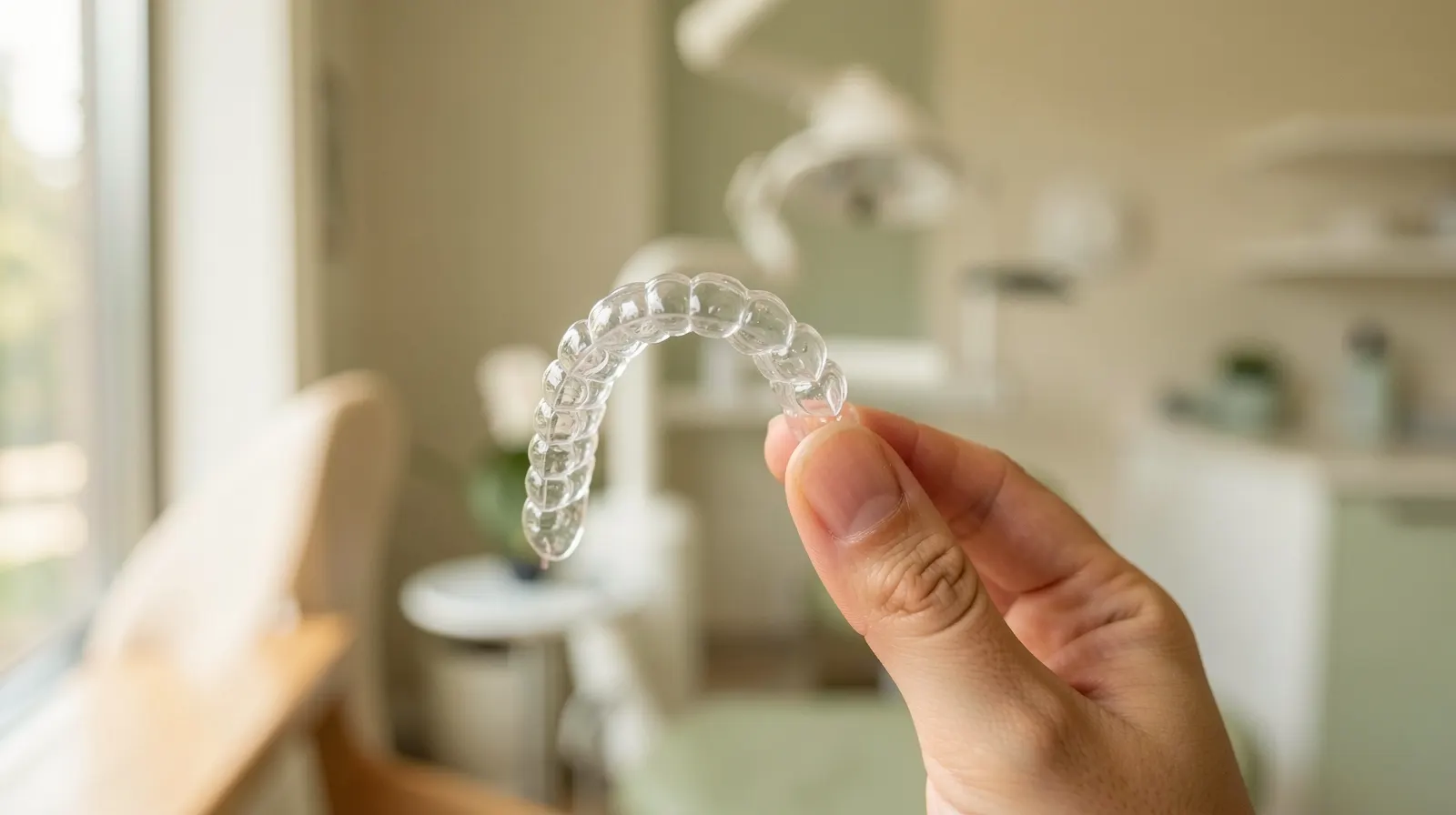
Clear Aligners Near Cupertino: How They Compare to Braces
· Eclat Dental Studio
Research suggests clear aligners can produce results similar to braces in many suitable cases, but the evidence is mixed and of limited quality. Here's what it shows, what it doesn't, and what to ask at a consult.
Opening soon: Eclat Dental Studio’s estimated grand opening is February 1, 2027.
For many suitable, non-extraction cases, clear aligners can straighten teeth about as well as braces, but the evidence is still maturing and the quality of many studies is limited. Results depend heavily on careful planning and supervision by a dentist, not on the brand name alone. If you are weighing the two options from Cupertino, a consultation can show which fits your bite.
What does recent research say about aligners versus braces?
For years, patients were told braces were the only reliable choice for anything beyond minor crowding. The picture has become more nuanced. Systematic reviews of the literature suggest that Invisalign clear aligners and traditional braces can produce similar results in suitable cases that do not involve tooth extractions, though the evidence quality is limited and many of the trials are small. In plain terms: aligners look like a legitimate option for suitable patients, but nobody should promise that they work for everyone.
Comfort and hygiene findings are encouraging too. Some reviews suggest patients often report less pain early on with aligners and find it easier to keep teeth and gums clean, since the trays come out for brushing and flossing. Those are short-term observations, and larger long-term studies are still needed.
Can aligners correct a deep bite as well as braces?
A deep bite, where the upper front teeth cover too much of the lower ones, has traditionally been considered one of the harder problems for aligners. The evidence here is mixed. Some studies report encouraging results with aligners, while others have found no significant difference in treatment time and less overbite reduction with aligners, leading some researchers to conclude that braces may be more effective for deep bites.
A few things are worth keeping in mind:
- Many deep-bite studies are small, retrospective, or conducted at a single site, which limits how far their findings can be generalized.
- Braces and aligners may affect the vertical proportions of the face and the angle of the upper front teeth differently. A dentist weighs these trade-offs when choosing an approach.
- Individual factors, such as how deep the bite is and how consistently trays are worn, can matter as much as the type of appliance.
So the honest takeaway is that aligners may work for some deep bites in carefully selected patients, but braces remain a well-established option, and larger, longer-term studies are needed.
Why does dentist supervision matter more than the brand?
Every aligner system works through the same basic idea: a series of trays that move teeth in small steps. What differs from patient to patient is the plan behind those trays. A dentist will typically examine your teeth, gums, and jaw joints first, may use X-rays or 3D imaging when needed, and check that your gums and bone can support tooth movement.
Supervision continues after treatment starts. Dentists check that teeth are tracking the plan, that the bite is settling correctly, and that trays are being worn enough hours per day. The FDA has warned consumers about aligners sold directly to them without proper professional oversight, citing risks such as uneven bites, unintended tooth movement, and pain. Remote check-ins can be a useful supplement, but periodic in-person visits remain important.
What should Cupertino patients know before choosing?
Patients often ask similar questions, whether they live near Monta Vista, Rancho Rinconada, or Jollyman: how long will it take, will anyone notice, and how does it compare with braces for a teenager versus an adult? The honest answer is that it depends on the case. Crowding, spacing, and mild to moderate bite issues are often considered suitable for aligners. Significant jaw discrepancies, certain rotations, and cases needing extractions may be better suited to braces or a combined approach, but only an in-person evaluation can say for sure.
Aligners also depend on the patient. They work best when worn consistently, which is worth considering honestly for busy teens and adults. Braces are always on, which removes that variable.
Our Mountain View office is a short drive from Cupertino, so a planning visit and follow-ups are manageable. The investment varies with the complexity of your case, the number of aligners, any refinements, and retainers afterward. We accept all PPO dental plans and are in-network with Delta Dental. Our team speaks English, Mandarin, Cantonese, and Spanish.
Common questions about clear aligners and braces
Q: Are aligners faster than braces?It depends. Studies on treatment time are mixed: some find aligners shorter, others find no difference, and complex cases often take longer with aligners. Your own timeline depends on your bite and how consistently you wear the trays.
Q: Do aligners work for severe problems?Not always. Evidence for complex or severe malocclusions is less established, and a dentist may recommend braces or a combination of treatments for those cases.
Q: Do I still need a retainer afterward?Yes. Teeth tend to drift back after any orthodontic treatment, so retainers are a standard part of keeping your results with either aligners or braces.
Q: Is a mail-order aligner kit the same thing?No. Aligners sold without an in-person exam or professional supervision lack safeguards a dentist provides, and the FDA has warned about them.
Ready to compare your options?
If you are in Cupertino or a nearby city and want to know whether aligners, braces, or something in between suits your smile, we would be glad to walk you through it. Call our Mountain View office at (650) 917-8348 or visit eclatdentalstudio.com to schedule a consultation at 530 Showers Drive, Suite 3.
This article is general information, not a diagnosis or treatment recommendation. Only an in-person evaluation by a dentist can determine what is right for you.