Night Guards for Teeth Grinding in Menlo Park: Custom vs. Store-Bought
· Eclat Dental Studio
Custom or store-bought night guard for teeth grinding? What each does, what research says about guards, stress and sleep habits, and what to ask a dentist.
Opening soon: Eclat Dental Studio’s estimated grand opening is February 1, 2027.
A night guard protects your teeth from the wear of grinding, but it has not been shown to reliably stop the grinding itself. A dentist-made guard fits more precisely than most store-bought options, so dentists generally prefer it. The evidence on whether any approach, including a guard, reduces grinding is limited and mixed, so a guard is best thought of as protection for your teeth, with sleep and stress habits as something that may help some people.
This article is general information, not a diagnosis or personal medical advice. Stop using any guard that causes pain or changes how your teeth meet, and see a dentist.
What does a night guard actually do?
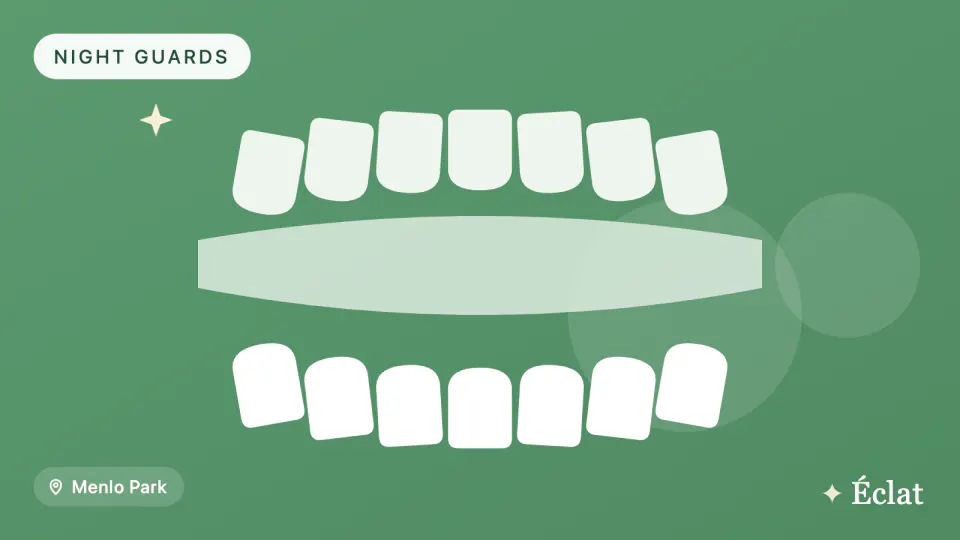
Grinding and clenching during sleep (sleep bruxism) can wear down enamel, chip teeth and restorations, and leave your jaw muscles sore in the morning. A night guard, also called an occlusal splint, is a thin plastic cover for your upper or lower teeth. It gives your teeth a smooth surface to press against, so the guard takes the wear instead of your enamel.
It helps to be clear about what a guard is not. Studies of splints suggest they may ease muscle soreness and help protect teeth, though the evidence for pain relief is low in quality and mixed. Splints do not reliably reduce how often you grind. In some studies the effect on muscle activity faded over a few weeks. Most of those studies were small and followed patients for a short time, so the long-term picture is still being filled in.
Custom vs. store-bought: what is the difference?
Store-bought guards come in two main types. Stock guards are one-size-fits-all. Boil-and-bite guards are softened in hot water and shaped by biting into them. Both cost less and you can get one right away. Neither is shaped to your particular bite, so they can feel bulky, shift during the night, or press unevenly on your teeth.
A custom guard is made from an impression or digital scan of your teeth, so it fits your bite closely. Your dentist can also check the fit at a follow-up visit and adjust it. Dentists usually recommend a custom guard when you grind heavily, have crowns, veneers or implants to protect, or already have jaw pain. Some people find a poorly fitting guard uncomfortable, and a hard, ill-fitting guard or one used for a long time can affect how your teeth meet.
- Store-bought: lower upfront cost and easy to find, but a looser fit and often less comfortable for all-night wear.
- Custom: an investment that varies with the design and materials, but a closer fit, and the dentist's check on how your bite meets the guard.
Mail-order guards made from impressions you take at home sit in between. They are tailored to some degree, but they do not always fit well, and a dentist has not checked them. If you want to try a store-bought guard, it is worth having a dentist confirm first that grinding is really what is wearing your teeth.
What does research say about guards and the cause?
Some small randomized trials have compared splints with other approaches, such as botulinum toxin injections or sleep hygiene and relaxation routines, in adults with sleep bruxism. Results have been mixed. Some trials found similar improvements in jaw-muscle pain across approaches, and others found little difference in how often people ground their teeth.
Sleep hygiene means steady bedtimes, a calm wind-down routine and a dark, quiet bedroom. Progressive muscle relaxation means tensing and releasing muscle groups one at a time. Evidence for these behavioral approaches in sleep bruxism is low in certainty, and not every study of relaxation techniques has shown a benefit.
Treat the research as early, not settled. The practical takeaway is that a guard protects your teeth, and habit and stress work may help some people, though it is not guaranteed to reduce grinding.
What else can help with grinding?
Stress and anxiety are commonly associated with grinding. Caffeine late in the day, alcohol, smoking, and some medications can also contribute. Sleep problems matter too. If you also snore loudly or wake up unrefreshed, ask a physician about screening for sleep apnea, because treating it may reduce grinding for some people.
- Keep a consistent bedtime and a screen-free wind-down.
- Cut back on caffeine in the afternoon and evening, and on alcohol close to bed.
- Try a relaxation routine such as breathing exercises or progressive muscle relaxation.
- Notice daytime clenching, and rest your teeth slightly apart with your lips closed.
- Avoid chewing gum and hard objects, which keep jaw muscles working.
If you wake with ongoing jaw soreness, clicking, or headaches, those can point to a joint problem as well as grinding. Our page on TMJ and jaw pain care explains how that is evaluated.
Getting evaluated if you live in or near Menlo Park
If you live in Menlo Park, including Allied Arts, Sharon Heights, or Downtown, a visit usually includes a look at your wear patterns, your jaw muscles and joints, and your bite. If a custom guard makes sense, your dentist can discuss how it is made.
The drive from Menlo Park to our office at 530 Showers Drive, Suite 3, Mountain View is about 15-20 minutes via Highway 101 or El Camino Real. Our team speaks English, Mandarin, Cantonese and Spanish.
On insurance, we accept all PPO dental plans and are in-network with Delta Dental. Menlo Park is in San Mateo County, and we also accept Health Plan of San Mateo (HPSM). Coverage for night guards varies by plan, so we can discuss costs and what your plan may cover. If you do not have insurance, ask about our membership plan. Ask our team about payment options.
Common questions about night guards
Q: Will a night guard stop me from grinding?Not usually. It protects your teeth and may ease muscle soreness, but it does not reliably change the grinding itself. The evidence for any approach to reducing grinding, including splints, stress management and sleep habits, is limited and mixed, though these habits may help some people.
Q: Is a store-bought guard ever okay?Some people use one as a short-term stopgap, ideally after a dentist has confirmed that grinding is the problem. A poor fit, jaw pain, or dental work to protect are good reasons to move to a custom guard. Stop using any guard that causes pain or changes your bite.
Q: How long does a custom night guard last?It depends on the material, how hard you grind, and how you care for it. Dentists check it at regular visits and replace it when it wears thin or no longer fits.
Q: Should I wear a guard on my upper or lower teeth?A dentist will usually decide this based on your bite, your comfort, and which teeth or restorations need the most protection.
If you are unsure whether you need a guard, or which kind, a consultation can sort that out. Call (650) 917-8348 or visit eclatdentalstudio.com to schedule. We welcome patients from Menlo Park and nearby cities.