Partial Denture or Implant Bridge? Choosing in Los Altos
· Eclat Dental Studio
Weighing a removable partial denture against an implant-supported bridge? Here is how they compare on comfort, neighboring teeth, upkeep, and who each suits.
Opening soon: Eclat Dental Studio’s estimated grand opening is February 1, 2027.
A removable partial denture is the less invasive option, and it can work well when several teeth are missing and some healthy teeth remain. An implant-supported bridge is fixed in place and doesn't rely on neighboring teeth, but it needs surgery and enough healthy bone. For many Los Altos patients the right choice depends on how many teeth are missing, bone health, timing, and budget, and a dentist can sort this out with an exam and appropriate imaging.
This article is general education, not individual dental advice. Your options depend on an in-person exam.
How do partial dentures and implant bridges actually differ?
A partial denture replaces one or a few teeth and is taken out for cleaning and at night. It is typically held in place by clasps or attachments on your remaining natural teeth. It is non-surgical, so many people can start treatment sooner.
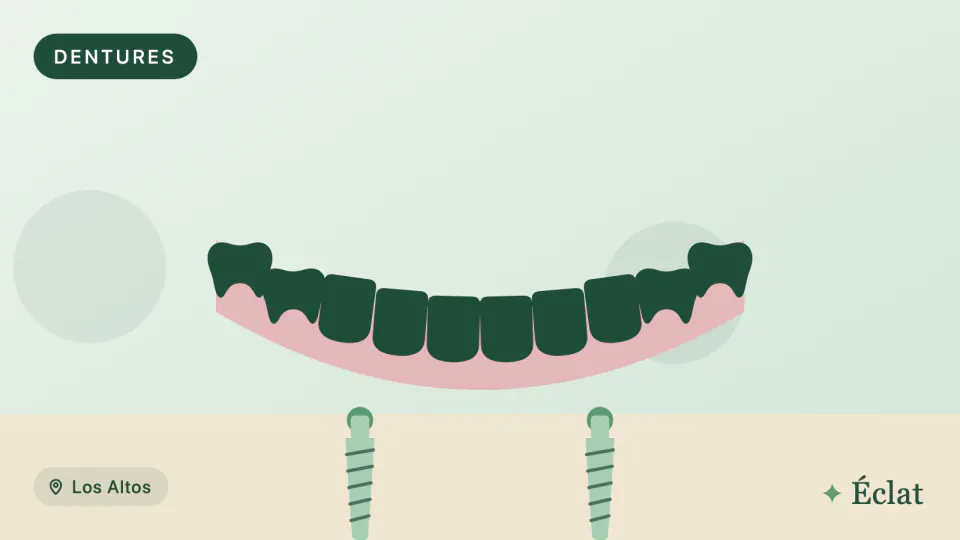
An implant bridge works differently. Implants act as new tooth roots in the jaw, and a bridge of replacement teeth attaches to them. Because the implants carry the load, the bridge is fixed rather than removable, and the neighboring teeth are left alone.
A conventional tooth-supported bridge is a third option. It anchors replacement teeth to the natural teeth on either side of the gap. A dentist can discuss how it compares for your situation.
What does the research say about comfort and satisfaction?
Studies of patient satisfaction have found mixed results, and many patients report good outcomes with either option. Some patients have reported higher satisfaction with implant-supported teeth, but those studies are often small and rely on self-reported answers, so treat them as a pattern, not a guarantee.
Research on quality of life, meaning how people feel about eating, speaking, and daily comfort, suggests implants can improve the stability of removable dentures. It does not show that implants are consistently better than well-made conventional options for every person. In other words, a good partial denture can still serve a patient well, and a more involved solution isn't automatically a happier one. Outcomes vary by individual.
What should I weigh before choosing?
- Neighboring teeth: Partial dentures lean on neighboring teeth for support, and clasp teeth can be more prone to plaque buildup and decay if cleaning is not thorough. An implant avoids that, because it doesn't need nearby teeth to be shaped or used as anchors.
- Daily routine: A partial must be brushed daily, removed at night, and stored in water or a denture-cleansing liquid. Some people don't mind this. Others find it tedious.
- Adjustment period: A new denture can feel strange at first. Speaking and eating take practice, and early follow-up visits to check the fit are common.
- Changes over time: The mouth changes, so dentures may need adjusting or replacing. A removable partial also does not prevent bone loss in the area where teeth are missing. If a denture keeps moving too much, dentists often discuss implants as a more permanent alternative.
- Timeline and surgery: Implants involve a surgical step and healing time, and fear of surgery or a long treatment period leads some patients to choose a removable option. Cost is another common factor.
- Risks and upkeep: Implants can fail or develop peri-implantitis, an infection and inflammation of the tissue around the implant. They need good daily cleaning and regular professional maintenance over the long term.
- Bone and health: Implants need enough healthy bone, and general health matters too. A dentist can evaluate bone with appropriate imaging to see whether implants may be realistic for you.
Is there a middle path?
Yes. Implants can also support a removable partial denture. This can suit someone who wants more stability without committing to a fully fixed bridge. A dentist can explain whether it fits your bite and your remaining teeth.
Timelines and scheduling for Los Altos families
Many families ask about timelines and scheduling. Those are good questions to raise early. A partial denture usually has a shorter timeline, while an implant bridge is spread over several visits with healing in between. Our general and family dentistry care also covers the checkups and gum health that both options depend on, since healthy gums and teeth help either one last.
Our Mountain View office at 530 Showers Drive, Suite 3 is convenient to Los Altos. Our team speaks English, Mandarin, Cantonese, and Spanish.
Common questions about partial dentures and implant bridges
Q: Which option protects my remaining teeth better?An implant bridge doesn't depend on neighboring teeth for support. A partial denture rests on them, so careful design and good hygiene matter. A dentist can assess how strong your remaining teeth are and can also discuss conventional bridges as another option.
Q: Can I start with a partial denture and switch to implants later?In some cases, yes, depending on a dentist's evaluation of your bone and gum health. Some patients use a partial first and add implants later. Ask about this at your consultation so your plan keeps that door open.
Q: How much will each option cost?The investment varies with the number of teeth, materials, imaging, and whether surgery is needed. After a consultation we can provide a written estimate, and our team can discuss coverage and payment questions. We accept all PPO dental plans and are in-network with Delta Dental, and coverage for each option is something our team can help you check.
Q: Is a partial denture a poor choice?No. For many people it is a sensible, well-tolerated solution, especially when surgery isn't desirable or bone is limited. The goal is the option that fits your mouth, health, and priorities.
Ready to talk through your options?
If you are comparing a partial denture with an implant bridge, a consultation lets us examine your teeth and walk you through realistic choices at your pace. Call (650) 917-8348 or visit eclatdentalstudio.com to schedule a visit at 530 Showers Drive, Suite 3, Mountain View, serving patients in Los Altos and nearby cities.