Crown or Onlay? When Menlo Park Patients Need Less Than a Full Cap
· Eclat Dental Studio
An onlay covers only the damaged part of a tooth and keeps more healthy enamel. How we decide between an onlay and a full crown for Menlo Park patients.
Being told a tooth needs a crown does not always settle the question. A full crown covers the whole visible tooth, which means shaping away a good deal of healthy structure to make room for it. An onlay, sometimes called a partial crown, covers only the damaged cusps and chewing surface and bonds to the walls that are still sound. When enough of the tooth remains to support one, an onlay is often the more conservative and equally dependable repair.
For patients coming to our Mountain View studio from Menlo Park, this is one of the conversations we have most often, and it is worth understanding before any preparation begins.
How much tooth each option removes
The difference is substantial. Preparing a tooth for a full crown typically removes around 60 to 75 percent of its structure, reducing it to a smaller core that the cap can fit over. An onlay preparation generally removes about 35 to 45 percent. Put another way, published reviews of back-tooth restorations find that a crown takes away roughly two-thirds of the natural tooth, while an onlay leaves most of it in place.
That preserved enamel and dentin is not just a matter of principle. It protects the nerve, keeps the root better supported, and leaves more options open if the tooth ever needs further work.
What modern onlays are made from
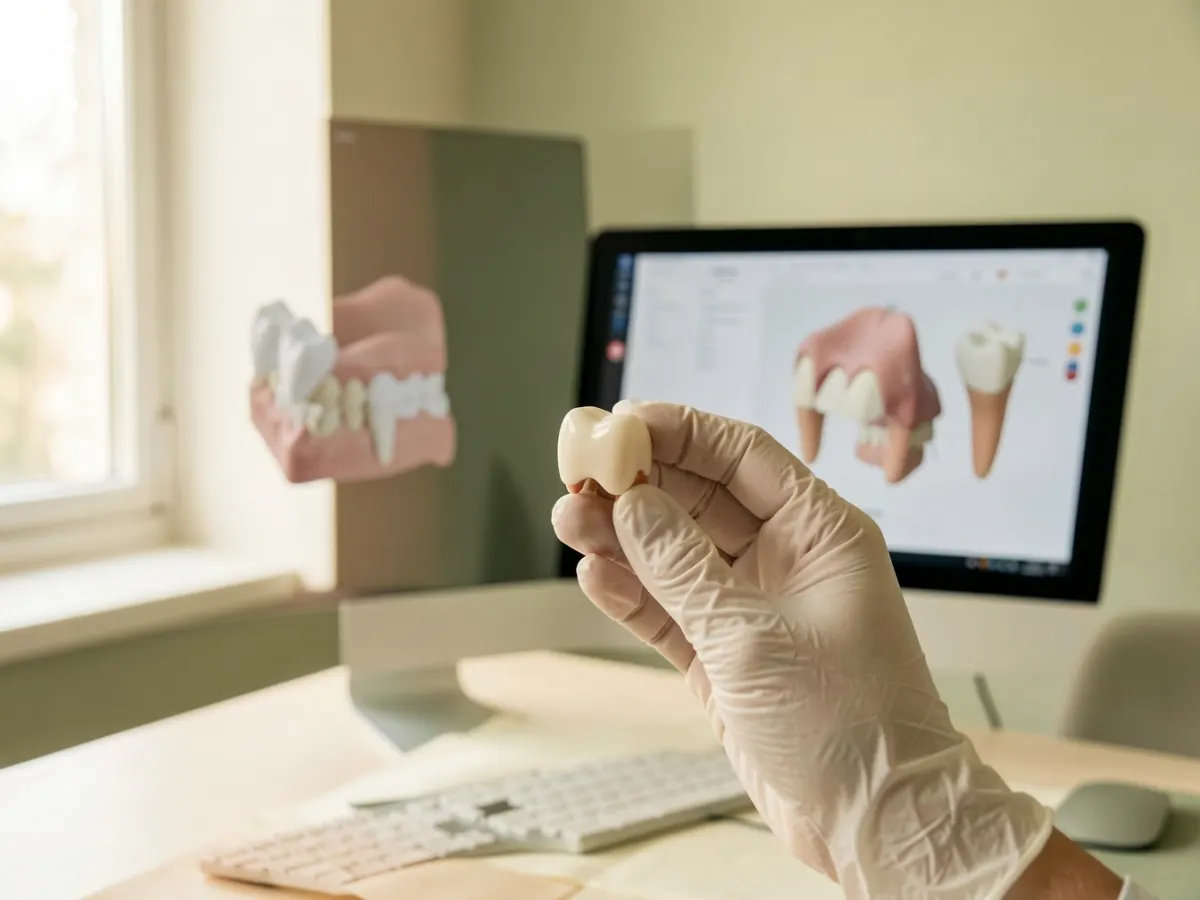
Today's onlays are usually made from lithium disilicate, a strong, tooth-coloured ceramic, and fixed with adhesive cements that bond to the tooth and help reinforce what remains. Many can be designed from a digital scan and milled in the studio, so like a same-day crown, an onlay is often finished in a single visit.
When an onlay is usually our first choice
We lean towards an onlay whenever the remaining tooth is strong enough, biologically and mechanically, to hold one. Typical examples:
- A molar with one broken or worn cusp whose side walls are still solid.
- An old, large silver filling that has cracked or started to leak, surrounded by enamel that is still in good condition.
- Decay on the biting surface that is too wide for an ordinary filling but has not undermined the whole tooth.
- A short tooth where cutting it down for a crown would leave too little to grip, or come uncomfortably close to the nerve.
The long-term evidence is encouraging. A retrospective study following ceramic inlays and onlays reported cumulative success above 92 percent at about 14.5 years, with yearly failure rates of around half a percent. When a tooth qualifies, an onlay is a proper, lasting restoration rather than a halfway measure.
When a full crown is the safer call
An onlay needs healthy walls to anchor to. When too much of the tooth is gone or weakened, full coverage becomes the better choice. We generally recommend a crown for:
- Molars after root canal treatment. These teeth tend to become more brittle, and their cusps can split under chewing without a crown wrapping around them. Premolars with thick remaining walls are sometimes an exception.
- Extensive damage. When more than half of the visible tooth is missing or unsupported.
- Cracks running towards the gumline. A crown holds the tooth together from all sides and helps stop the crack from spreading.
- Heavy wear from grinding. If several cusps have been flattened and the tooth has lost height, full coverage rebuilds it. A night guard then protects the result.
- Teeth that have already been through several large repairs that have failed.
How we decide
The choice is made on evidence rather than habit. We look at bitewing X-rays, a digital scan of the tooth and, where a crack is suspected, shine a bright light through the tooth to trace its path. The aim is simple: the most conservative restoration that will reliably stand up to your bite.
What feels different for you
- Preparation: onlay preparations are smaller and often quicker, though bonding them demands more care than cementing a crown.
- Sensitivity: because less dentin is removed, post-treatment sensitivity and later nerve irritation tend to be lower with onlays.
- Repairs: a small chip in an onlay can sometimes be smoothed or repaired. A failed crown usually has to be replaced entirely.
- Appearance: both look natural in ceramic. An onlay leaves more of your own tooth visible near the gum, which can look especially lifelike on upper premolars.
Questions we hear
Does an onlay last as long as a crown?
In a healthy mouth, published survival figures are similar, above 90 percent at five years for both, and well into the teens of years for well-bonded ceramic onlays. The main threats to either are new decay at the edges and untreated grinding.
Is an onlay cheaper?
There is no fixed difference. The fee depends on the tooth and the complexity of the case, and we provide a written estimate after your exam. Most PPO plans treat both as major restorative work.
I have Health Plan of San Mateo coverage. Can I still be seen?
Yes. We accept HPSM Medi-Cal dental, which many Menlo Park residents have, and we will explain what your plan covers for the tooth in question. Our HPSM page has more detail.
A second look before you commit
If you have been told you need a crown and wonder whether a smaller repair would do, we are glad to look. The studio is a straightforward trip down El Camino Real or Highway 101 from Menlo Park. Learn more about our restorative care, or call (650) 917-8348 to arrange an exam.