Same-Day Implants After Extraction in Mountain View: Who Qualifies
· Eclat Dental Studio
Same-day implants after an extraction work for some patients, but not all. Learn what research generally suggests and what a 3D exam can check for Mountain View patients.
Opening soon: Eclat Dental Studio’s estimated grand opening is February 1, 2027.
This article is general education, not a diagnosis or individual treatment advice. Candidacy and risks can only be determined by an in-person exam.
Short answer: placing an implant the same day a tooth comes out is possible for some patients, but not everyone. Research suggests results can be similar to waiting for the socket to heal when the bone around the tooth is healthy enough, the implant is stable at placement, and any infection is thoroughly cleaned out. An exam and 3D imaging help a dentist decide whether you are a good candidate.
What does a same-day implant actually mean?
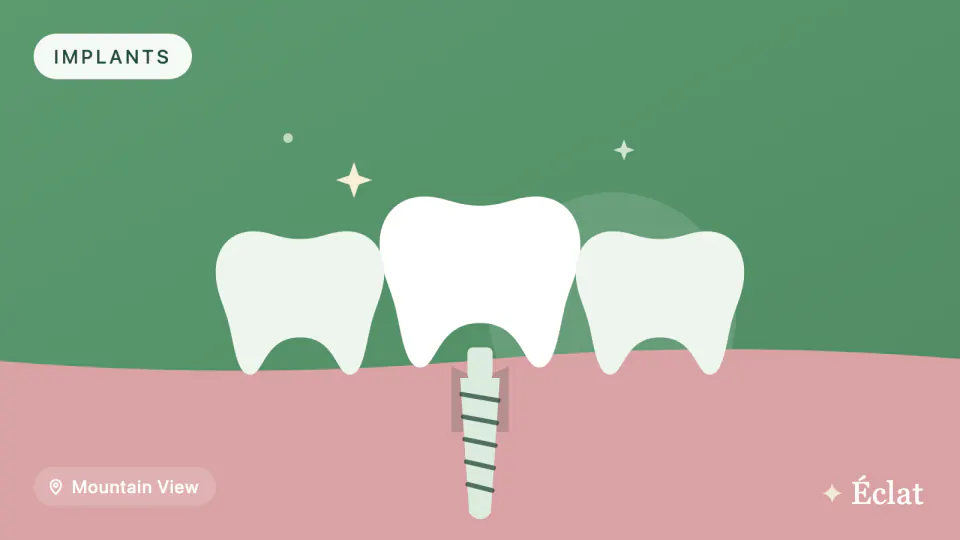
With the traditional approach, a tooth is removed, the area heals for a few months, and only then is the implant placed. With an immediate implant, the implant goes into the socket right after the tooth is removed, in the same visit. The main appeal is fewer procedures and a shorter overall timeline. Many people wonder about it because it can mean less time with a gap in the smile and fewer trips across a busy work week.
Faster is not automatically better, though. The socket is shaped by the tooth that was there, and how well that shape and the surrounding bone are preserved determines whether an implant can be placed safely right away.
Who tends to qualify?
A dentist will typically look at a handful of things before recommending same-day placement:
- The cheek-side bone wall. For front teeth especially, the thin plate of bone on the outer surface of the socket supports the gum line. When it is intact, immediate placement tends to go well.
- Enough bone beyond the socket. The implant needs solid bone below and beside the root tip to hold steady from day one. This initial stability, often called primary stability, is a key factor in whether an implant can be placed immediately.
- Gum thickness and health. Thicker, healthy gum tissue is generally more forgiving.
- Bite and habits. Heavy grinding, smoking, and poorly controlled health conditions can all tip the decision toward waiting.
- Tooth location. Front teeth and premolars are the most studied sites. Molars have wider, more complex sockets and are often more demanding.
What does the recent research say?
Systematic reviews of immediate implants in the upper front jaw have generally reported high implant survival rates, both when the outer bone wall is intact and when it is damaged. Changes in bone thickness and gum position have often looked small and comparable between the two situations, although some reports suggest slightly more gum recession on the cheek side when the outer wall is damaged.
Reviewers have also been clear about the limits. The overall quality of evidence is low, few studies compare the two situations head to head, and complications are not always reported. In plain terms, an intact outer wall is the more reassuring starting point, and damaged sockets may carry more risk of gum recession, but the evidence is still maturing and should not be read as a guarantee for any one person.
What about an infected tooth?
Infection has traditionally been seen as a reason to wait, and many dentists still prefer to treat the infection first and place the implant later. Some studies have reported that implants placed right after extraction in sockets with a long-standing infection at the root tip did reasonably well compared with implants in healthy sockets. In those reports, careful cleaning was the key condition: removing all the inflamed tissue, disinfecting the socket, and often using bone graft material. The studies were generally small, follow-up times varied, and most involved front or premolar teeth. So this is early evidence, not proof that every infected tooth is a candidate, and it is not a reason to rush an implant into an infected site.
How does the exam decide?
A regular X-ray is flat. It cannot show how thick the outer bone wall is, how much bone sits below the root, or how the socket is angled. A 3D cone-beam scan can show this. From that scan, a dentist can estimate bone height and width, bone density, and the shape of the socket, then discuss one of three paths:
- Extraction and implant on the same day.
- Extraction with bone grafting now, and the implant a few months later.
- Another option altogether, if the implant is not the right fit.
Our team speaks English, Mandarin, Cantonese, and Spanish, so you can talk through the plan in the language you are most comfortable with. If you want to learn more about how we approach dental implant care, that page is a good place to start.
What about cost and insurance?
The investment varies with complexity: whether a graft is needed, how many teeth are involved, and the type of restoration. After your exam, you can receive a written estimate. We accept all PPO dental plans and are in-network with Delta Dental, and coverage for implants varies by plan, so it helps to check your benefits. Ask our team about payment options.
Common questions about same-day implants
Q: Will I leave with a permanent tooth the same day?
Not always. Same-day usually refers to placing the implant itself. Whether a temporary tooth can be attached that day depends on how stable the implant is, and the final crown typically comes after the implant has healed.
Q: Is a same-day implant less safe than waiting?
For well-selected patients, research suggests survival is comparable. The risks include cosmetic risks such as gum recession in the front of the mouth, as well as the general risks of any implant surgery, such as infection or an implant that does not integrate or lacks enough stability. Your dentist can review these with you, which is why careful case selection matters.
Q: What if my tooth has an abscess?
Some dentists prefer to treat the infection first and place the implant later. In certain cases, placement may be considered after the area is thoroughly cleaned, but this depends on the individual situation. An in-person exam and 3D imaging help decide.
Q: Is there a chance I will be told to wait?
Yes. If the bone is thin or missing, or the implant cannot be made stable at placement, waiting and grafting first is often the more predictable route, and that is a sound recommendation, not a setback.
Next steps
If you have a tooth that needs to come out and want to know whether a same-day implant makes sense, a good first step is a consultation and an exam, which may include 3D imaging. We serve patients in Mountain View and nearby cities such as Los Altos, Palo Alto, and Sunnyvale. Call (650) 917-8348 or visit eclatdentalstudio.com to schedule a visit at 530 Showers Drive, Suite 3.