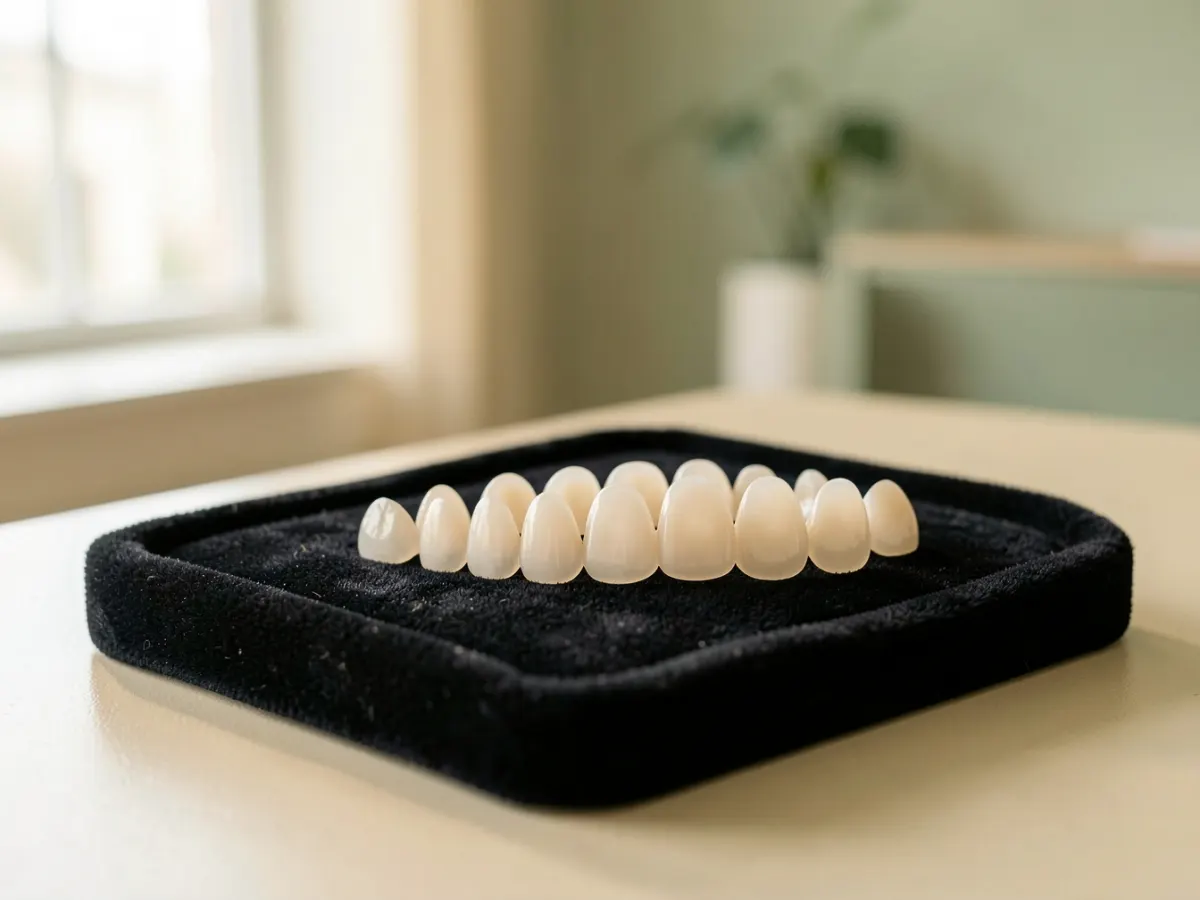
Try Before You Commit: The Trial Smile Mock-Up, Explained for Palo Alto Patients
· Eclat Dental Studio
A trial smile lets you wear your proposed makeover over your own teeth, with no drilling, before anything permanent. How it is made and what to look for while wearing it.
Committing to veneers or crowns on your front teeth is a significant decision, and it is reasonable to want more than a drawing or a computer image before you make it. A trial smile mock-up offers exactly that: a temporary, tooth-coloured version of your planned smile, fitted over your existing teeth, that you can see, feel and speak with. For patients coming to us from Palo Alto, it is often the moment a makeover stops being abstract and becomes something they can judge with confidence.
What a mock-up is
A mock-up is a full-size, three-dimensional preview of the proposed design, made from a provisional resin and placed directly on top of your natural teeth. Because nothing is removed from the teeth to fit it, most trial smiles involve no anaesthetic and no permanent change. When it comes off, your teeth are exactly as they were.
It sits between the planning stage and the finished restorations. A digital design, which we describe in our article on digital smile design, shows the idea on a screen. The mock-up shows it in your mouth, next to your lips, your gums and the rest of your face, where small differences in length or width become obvious in a way a flat image cannot convey.
How it is made
- Records. We take a digital scan of your teeth and photographs of your face and smile, and agree the goals: which teeth, what changes, and what should stay as it is.
- The diagnostic wax-up. Using those records, a model of the proposed smile is created, either by adding wax to a model of your teeth or by designing and printing it digitally. This model is the blueprint for everything that follows.
- The intraoral trial. A clear or putty mould is made from the wax-up, filled with tooth-coloured resin and seated over your teeth. After a few moments it sets, the mould is removed, and the excess is trimmed. You are now wearing the proposed smile.
For smaller changes, a quick freehand version can sometimes be sculpted in composite at the consultation itself. It is less precise than one made from a wax-up, but it gives an immediate sense of direction.
What to pay attention to while wearing it
The mock-up is only useful if you look at it critically. These are the questions we suggest you ask yourself.
Appearance
- At conversation distance, do the teeth look like they belong to your face?
- Does the length feel right when your lips are relaxed, and when you smile fully?
- Do the edges of the upper teeth follow the curve of your lower lip?
- Is the width in proportion, or do the teeth look too broad or too narrow?
Speech
- Count from sixty to seventy, and say words with "f", "v" and "s" sounds. Changes to the length or thickness of front teeth show up first in these sounds.
- Notice whether your lips close comfortably over the teeth.
Bite and comfort
- Close gently and slide your jaw from side to side. Does anything catch?
- Does the new shape feel bulky against your lips or tongue?
Other opinions
- Take photographs in natural light, or show someone whose judgment you trust.
Giving feedback
This is the stage to be specific. Would you like the edges softer or more rounded? A touch shorter? Less uniform, so the teeth look more natural? Changes at the mock-up stage are simple and expected; they are the reason the trial exists. We adjust the design and, if needed, make a second mock-up until the result feels right to both of us.
What the mock-up cannot show
Provisional resin is a good stand-in but not a perfect one. It cannot reproduce the depth and translucency of layered porcelain, so the finished restorations usually look more lifelike than the trial. Shade is also only approximate at this stage; the final shade is chosen separately, and if you plan to whiten your natural teeth, that should happen first. The mock-up is about shape, proportion, speech and bite.
Why it matters for your teeth
Preparing a tooth for a veneer or crown often means removing a thin layer of enamel, and that cannot be undone. The mock-up gives both of us a chance to confirm the plan before that step. It also guides the clinical work: with the agreed shape in front of us, we can see where material only needs to be added and preserve as much healthy enamel as possible. In some cases this supports very thin, conservative veneers, explained further in our veneer step-by-step guide.
After you approve the design
Once you are happy, the approved mock-up becomes the reference for the rest of treatment. It guides how the teeth are prepared, informs the provisionals you wear while the ceramist works, and is sent to the laboratory so the final restorations follow the shape you signed off on.
Questions about trial smiles
Does a mock-up hurt?
It should not. The material rests on the surface of your teeth, so numbing and drilling are rarely needed.
How long can I keep it on?
A chairside preview is usually removed the same day. A longer trial can be left on briefly so you can live with the design, and we will explain how to care for it in the meantime.
What if I change my mind entirely?
That is a perfectly good outcome. The mock-up comes off, your teeth are unchanged, and you have lost nothing but an appointment.
Is a mock-up only for veneers?
It is also useful before crowns, bonding and broader makeovers that combine several treatments.
See your plan before you decide
Eclat Dental Studio is in Mountain View on Showers Drive, a short journey from Palo Alto along El Camino Real, Central Expressway or by Caltrain. Learn more on our smile design page or call (650) 917-8348 to arrange a consultation.