Snap-In Implant Dentures for Cupertino Patients: How They Work
· Eclat Dental Studio
Snap-in implant dentures click onto a few dental implants for a steadier fit. Learn how they work, who may qualify, and what upkeep looks like for Cupertino patients.
Opening soon: Eclat Dental Studio’s estimated grand opening is February 1, 2027.
Snap-in implant dentures, also called implant overdentures, are removable dentures that click onto a small number of dental implants so they stay steadier when you eat and speak. For a fully toothless lower jaw, two implants have long been a standard starting point, and many people notice better stability and chewing than with a conventional denture. Below we explain how the process works, who tends to qualify, and what upkeep involves, with Cupertino patients in mind.
How do snap-in implant dentures work?
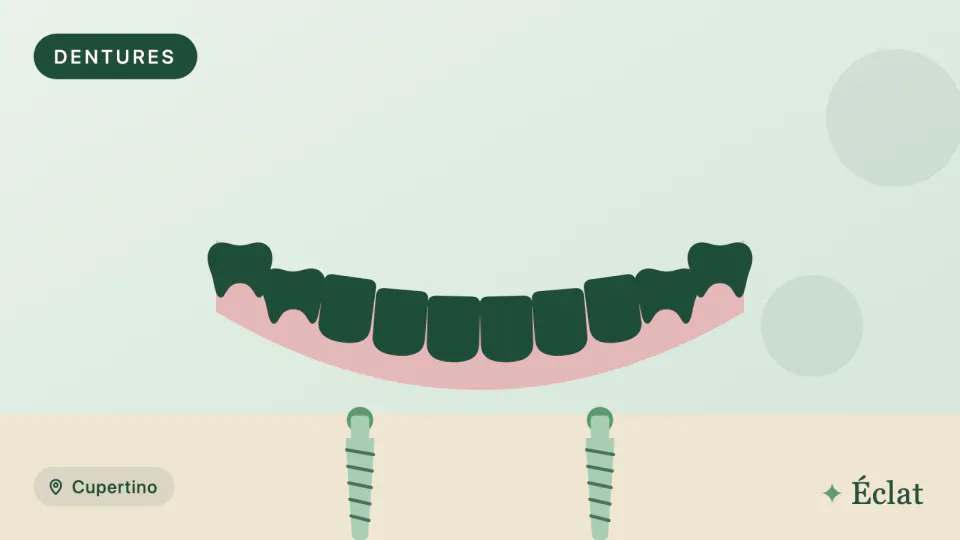
Implants are small titanium posts placed in the jawbone, where they act like artificial tooth roots. After the bone has healed around them, small attachments on the implants (often a ball or low-profile stud design) connect with matching housings built into the underside of the denture. You press the denture into place and it clicks on; you lift it off for cleaning and rest.
Because the denture is removable, it differs from a fixed implant bridge, which stays in the mouth and generally needs considerably more implants and more extensive surgery. Professional consensus statements have long supported two implants in the front of the lower jaw as a standard option for a toothless lower jaw. Studies report high implant survival rates when cases are carefully planned, though individual results vary.
What are the benefits compared with a regular denture?
Patients with conventional lower dentures often report chewing difficulty and end up changing what they eat. Research on implant-retained dentures points to several possible advantages:
- Stability: the denture tends to resist shifting and lifting.
- Chewing and speech: some studies suggest both can improve.
- Ridge preservation: implants may help limit the gradual bone shrinkage that comes with wearing a conventional denture, but evidence on bone preservation is mixed. It appears stronger for the front of the lower jaw and weaker elsewhere.
- Quality of life: some studies suggest higher satisfaction overall.
It is also worth being realistic. Treatment takes at least two phases, a surgical phase and a prosthetic phase, and each has its own risks. Nerve irritation causing lasting numbness in the lip is uncommon but possible, and a restoration can be weak if too few or undersized implants are used. Careful planning is how dentists reduce those risks.
Am I a candidate for snap-in dentures?
A dentist will typically look at whether you have enough healthy bone to hold the implants and whether your body can heal without complications. A few factors come up often:
- Diabetes: it can slow healing, but it can frequently be controlled well enough to allow implants.
- Smoking: it interferes with bone healing and may change the recommendation.
- Certain osteoporosis medicines: some drugs in this class can affect healing, so tell your dentist about every medication you take.
- Age: age by itself is not a barrier, though bone condition and general health still matter.
Bone quality varies by location. The front of the lower jaw tends to be the strongest area, which is one reason it is the classic site for two-implant dentures. The upper jaw is different: upper-jaw overdentures generally need more implants than the lower jaw, and a dentist determines the number after an exam. A dentist may use x-rays or 3D imaging to evaluate your bone.
What does treatment and upkeep look like?
- Consultation and exam, with imaging as a dentist recommends.
- Implant placement (the surgical phase).
- A healing period, whose length varies from person to person.
- Fitting the denture with its snap-in attachments (the prosthetic phase).
- Follow-up visits to check the fit and the attachments.
Snap-in dentures are not maintenance-free. Repeated putting-in and taking-out gradually reduces how firmly the denture clicks on, and the soft plastic inserts inside the attachments wear faster than metal parts. Loss of retention, or the need for a small adjustment, is among the most common issues with these dentures. Inserts are usually replaced rather than repaired, and the denture may need relining as the gum ridge changes over time. Plan on regular checkups, at intervals your dentist recommends (often every few months to a year), and ongoing dental implant care lets your dentist assess the implants, the attachments, and the denture together.
Snap-in dentures for patients coming from Cupertino
People considering snap-in dentures often have practical questions: how many visits, how long the process takes, and how to stay comfortable throughout. Our Mountain View office is a short drive from Cupertino. Our team speaks English, Mandarin, Cantonese, and Spanish, so relatives can join the conversation in the language they prefer.
We accept all PPO dental plans and are in-network with Delta Dental. Coverage for implant-related treatment varies by plan, so please contact our office to discuss coverage and costs. Cost depends on the number of implants, case complexity, and materials, and varies by plan.
Common questions about snap-in implant dentures
Q: How many implants will I need?For a toothless lower jaw, two is the commonly recommended minimum. The right number depends on your bone and bite. Upper-jaw overdentures generally need more implants than the lower jaw, and a dentist will confirm the number after an exam and imaging.
Q: Will the snap-in parts wear out?Yes, the small inserts that provide the snap gradually lose grip and are replaced as part of routine maintenance. This is normal and expected.
Q: Can I still get implants if I smoke or have diabetes?Possibly. Well-controlled diabetes does not always rule out implants, while smoking can interfere with healing. A dentist will weigh your overall health and may suggest changes or alternatives.
Q: Am I too old for implant dentures?Age on its own is not considered a barrier. Bone, general health, and healing capacity matter more.
Ready to talk it through?
If you are in Cupertino or a nearby city and wondering whether snap-in dentures fit your situation, we would be glad to review your options and discuss next steps and costs. Call (650) 917-8348 or visit eclatdentalstudio.com to schedule a consultation at 530 Showers Drive, Suite 3, Mountain View.
This article is general information, not a diagnosis or personalized treatment advice. Please consult a licensed dentist about your situation.