Snap-In Implant Dentures in East Palo Alto: Stability & Coverage
· Eclat Dental Studio
How many implants does a snap-in denture need? What 2025 research says about stability, chewing, and long-term outcomes, plus coverage questions for East Palo Alto patients.
Opening soon: Eclat Dental Studio’s estimated grand opening is February 1, 2027.
A denture that clips onto even one or two dental implants is usually much more stable than a conventional denture, and research generally links it to better chewing and higher satisfaction. How many implants you need depends on your jaw, your bone, and your budget, and the long-term data on fewer or smaller implants is still maturing. A consultation that includes a 3D scan is a reliable way to find your own answer.
What is an implant-retained (snap-in) denture?
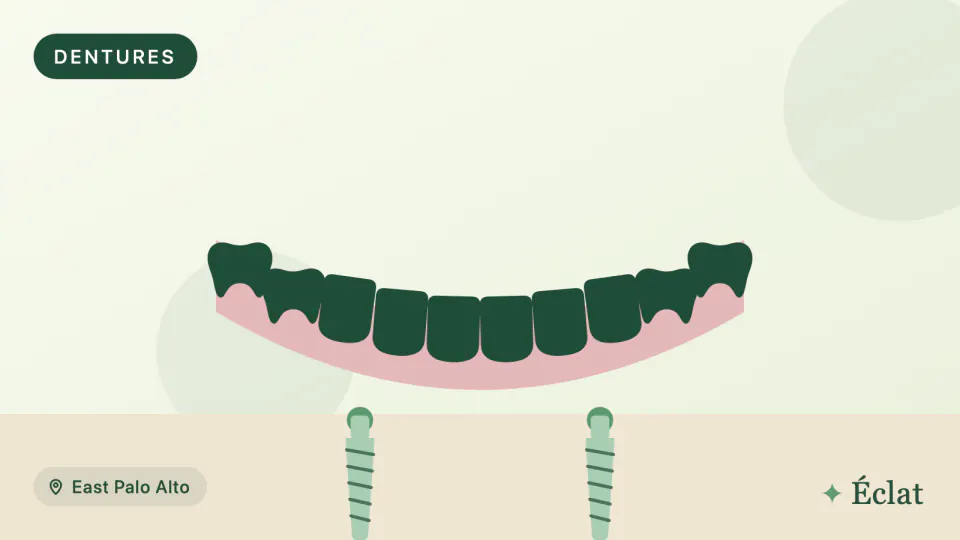
An implant overdenture is a removable denture that attaches to a small number of dental implants through snap-style connectors. Because the implants anchor it, the denture resists the sliding and lifting that many people struggle with, especially on the lower jaw, where there is less surface area and the tongue constantly moves the denture.
Unlike a fixed full-arch bridge, you can take it out to clean it, which many people find easier to keep hygienic. It also generally needs fewer implants than a fixed option, which is one reason it comes up often for patients weighing comfort against investment.
What does recent research say about stability, chewing, and satisfaction?
Several lines of evidence point in the same direction:
- Compared with a conventional denture, people wearing implant overdentures report better chewing ability, eat a wider range of foods, and avoid fewer hard foods. Satisfaction is also higher in most studies. A 2025 review did not find a consistent nutritional advantage, so the benefit is best described as comfort and function rather than a guaranteed diet change.
- For the lower jaw, consensus statements from dental research groups recommend a two-implant overdenture as a first-choice option. Adding more than two does not appear to improve patient-reported results much.
- One implant can work too. A randomized trial with long-term follow-up found that a single central implant performed similarly to two implants for stability and bone health. A 2025 review of reviews on this question found promising short-term results but called the long-term evidence uncertain and the satisfaction findings inconclusive.
In plain terms: a lower denture held by one or two implants can be a meaningful improvement over a loose conventional denture for many patients, but whether one is enough for a particular person is an individual decision.
What about mini implants?
Mini implants are narrower, and they are sometimes used when bone is limited or when a patient wants a less invasive option. A large 2025 analysis pooling 39 studies, covering nearly 3,800 mini implants and just over 1,000 overdentures, found roughly 91% of mini implants still in place at seven years. That is encouraging, but there are important caveats:
- The average follow-up in those studies was a little over two years, so the seven-year figure is an estimate rather than a long track record.
- Survival was lower in the upper jaw than in the lower jaw, and lower with two mini implants than with four in the lower jaw.
- Maintenance is real: connector parts wear, dentures can crack, and relines are common over time.
Data for the upper jaw is still limited. Because upper jaw bone is often less dense and the denture covers the palate differently, dentists often plan more implants there than for the lower jaw.
How many implants might be needed?
There is no one-size answer. A dentist will typically weigh:
- Bone volume and density. 3D (CBCT) imaging is commonly used to evaluate bone in three dimensions before recommending a number and placement of implants.
- Upper or lower jaw. Lower overdentures can often be stable with fewer implants than upper ones.
- Health and habits. Diabetes, smoking, and teeth grinding can influence how implants do over time. A dentist evaluates each person's individual health factors as part of planning.
- Priorities and budget. Fewer implants usually means a lower investment now, with the trade-off of possibly more adjustment or upkeep later.
The overall investment varies with the number of implants, the type of connectors, and whether bone grafting is needed. Our team can help you understand your insurance benefits as you weigh your options.
Coverage and access for East Palo Alto patients
Patients in East Palo Alto often ask two things first: will insurance help, and how far is the drive? On coverage, our practice accepts all PPO dental plans and is in-network with Delta Dental. Benefits for implant-related care vary by plan and often have limits, so we suggest checking your plan details and letting our team help you interpret them. We also accept Health Plan of San Mateo (HPSM). Coverage for implant-related treatment under public plans is often very limited or unavailable, so please confirm with your plan before planning treatment.
On logistics, our Mountain View office is a short drive via Highway 101 (times vary with traffic), and our team speaks English, Mandarin, Cantonese, and Spanish, which many East Palo Alto families appreciate when discussing a decision like this.
If you are weighing a denture upgrade, a consultation with a dentist about dental implant care is a good place to start, since implant planning begins with a close look at your gums and bone.
Common questions about snap-in implant dentures
Q: Is a snap-in denture the same as a fixed implant bridge?No. A snap-in denture is removable for cleaning, while a fixed bridge stays in place. Overdentures generally use fewer implants.
Q: Is one implant enough?For some lower-jaw cases, early research suggests a single implant can perform similarly to two. The long-term evidence is still maturing, and two implants remain the more established option.
Q: Will I still need relines or repairs?Yes, that is normal. Connector parts wear and dentures may need relining or occasional repair, so plan on regular maintenance visits.
Q: Can I use dental insurance for this?It depends on your plan. Many plans limit implant-related benefits, so our team can help you understand your insurance benefits.
Take the next step
If you are ready to find out which option fits your jaw, your bone, and your budget, call our Mountain View office at (650) 917-8348 or visit eclatdentalstudio.com to schedule a consultation. We are happy to serve patients in East Palo Alto and nearby cities, and there is no pressure to decide at the first visit.
This article is general education and not a substitute for an examination and personalized advice from a licensed dentist.