Snap-In Dentures in Mountain View: Two Implants or Four?
· Eclat Dental Studio
Two or four implants for a snap-in lower denture? Here is what recent research suggests about stability, survival and trade-offs, for Mountain View patients weighing options.
Opening soon: Eclat Dental Studio’s estimated grand opening is February 1, 2027.
Short answer: A lower denture that snaps onto implants is generally reported to feel steadier and more comfortable than a conventional denture, and two implants is a well-studied starting point. Four implants can add stability and may hold up slightly better in some research, but the right number depends on your jaw, your bone and your budget. It is not a one-size answer, and a consultation, with 3D imaging where a dentist recommends it, is how you find yours.
What does a snap-in implant denture actually do?
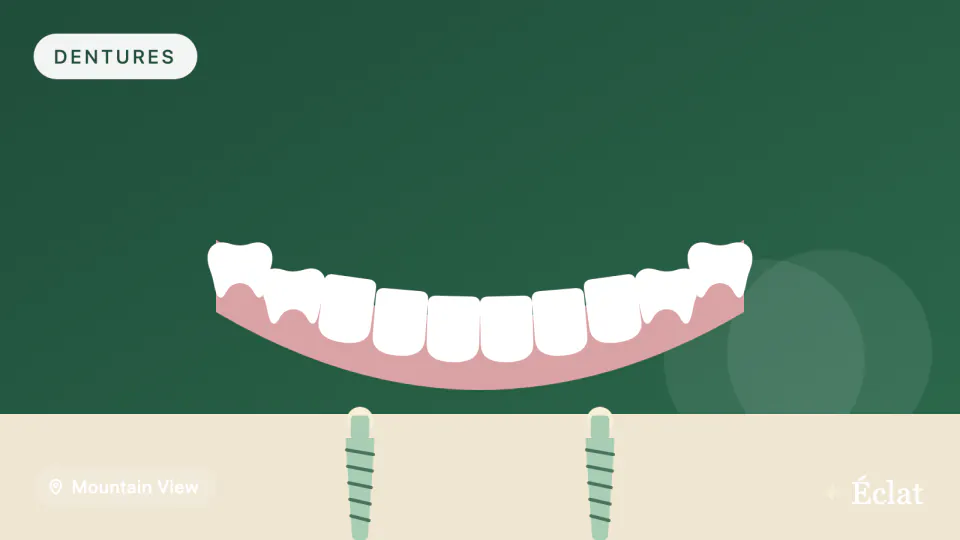
A snap-in denture (an implant overdenture) is a removable denture that clips onto small attachments on dental implants placed in the jawbone. The implants act like anchors, so the denture resists the sliding and lifting that make a lower conventional denture so frustrating. You still take it out to clean it, but it stays put while you eat and talk.
The lower jaw is where this matters most. The lower denture has no suction to lean on, and it rests on a ridge that tends to shrink over time. Reviews of randomized trials comparing two-implant lower overdentures with conventional dentures generally find better stability, chewing and overall satisfaction with the implants. Those trials were small, followed patients for a limited time and varied in quality, so the honest summary is a consistent benefit, not a precisely measured one.
Is one or two implants enough? What recent research suggests
Researchers have also asked whether even one implant can do the job. Some recent systematic reviews suggest a single implant may have short-term advantages, such as lower rates of implant loss, prosthesis failure and bone loss around the implant. The longer-term picture was uncertain, and results on satisfaction, quality of life and maintenance needs were inconclusive. Other pooled analyses found no clear survival difference between one and two implants over about five years.
What this means for you: the evidence supports implants in small numbers as an improvement over a conventional lower denture, but it does not yet show that one implant is as reliable as two over the long run. Two implants remain the most familiar and most widely studied option. Dentists often treat a single implant as a case-by-case choice rather than a default.
When would four implants make more sense?
Some older comparisons of two versus four implants for the lower jaw found high survival in both groups, with no meaningful difference in patient satisfaction. Four implants tended to reduce some maintenance needs, since the load is shared across more anchors.
A recent pooled analysis of mini implants (narrower implants, sometimes used when bone is thin) covered thousands of implants and about a thousand overdentures. It estimated roughly 91 percent survival at seven years. That is encouraging, but two cautions apply. Most of the studies followed patients for only a couple of years, so the seven-year figure rests on a small number of implants. The authors also noted that these dentures often need repairs or attachment replacements. Within that analysis, lower-jaw dentures on four mini implants did slightly better than those on two, and upper-jaw results were lower than lower-jaw results.
A dentist will typically weigh several things when recommending a number:
- Bone volume and density: thinner or softer bone often favors more implants or a different design.
- Upper versus lower jaw: upper dentures usually need more implants, because bone there is softer and the denture has less to grip.
- Bite forces and habits: grinding or clenching can wear attachments and fracture denture bases faster.
- Health factors: diabetes, smoking and certain medications can affect how implants heal and last.
- Budget and long-term upkeep: more implants mean a larger upfront investment, while fewer may mean more frequent adjustments later.
What Mountain View patients should expect from a consult
Common questions people ask are how long the process takes and what upkeep looks like. The first step is a clear picture of your jaw. A dentist may recommend 3D imaging (CBCT), either on-site or through a referral imaging center, to evaluate bone height and width before any plan is made.
Placement of implants, healing time and the denture itself are planned around what the exam and imaging show. Part of the same conversation is how the implants will be cared for over the years, which is why dental implant care and gum health are worth discussing up front. Snap-in dentures also need routine checkups, periodic attachment changes and relines as the jaw changes.
Cost varies with the number of implants, the type of attachments and the complexity of your case. You will receive a written estimate after your consultation. We accept all PPO dental plans and are in-network with Delta Dental, and our team can walk you through what a plan may or may not cover. Ask our team about payment options if you are paying out of pocket.
Our office is at 530 Showers Drive, Suite 3, Mountain View, CA 94040. Our team speaks English, Mandarin, Cantonese and Spanish, so family members can join the conversation comfortably.
Common questions about snap-in implant dentures
Q: Do I need four implants to get a good result?Not necessarily. Research on lower dentures shows good outcomes with two implants, and four may add stability or reduce some maintenance in certain cases. Your bone and bite determine which is reasonable.
Q: Can I get a snap-in denture for my upper jaw?Sometimes, but upper dentures usually need more implants, and the research shows lower survival there than in the lower jaw. A dentist's exam, and 3D imaging if recommended, helps determine whether it is a good fit.
Q: Will the denture ever need repairs?Commonly, yes. Attachments wear and need replacing, and the denture base can occasionally crack. Regular checkups keep small issues small.
Q: Are mini implants as good as standard implants?They can be a useful option when bone is limited, and survival in recent pooled data looks encouraging. Long-term follow-up is still limited, so a dentist will weigh them against standard implants for your situation.
Ready to talk through your options?
If your denture slips, rubs or limits what you eat, a consultation can show whether two implants, four, or another approach fits you. We are happy to answer your questions. Call (650) 917-8348 or visit eclatdentalstudio.com to schedule.
This article is general education, not a diagnosis or individual treatment advice. Results vary, and only an in-person exam can determine what is right for you.