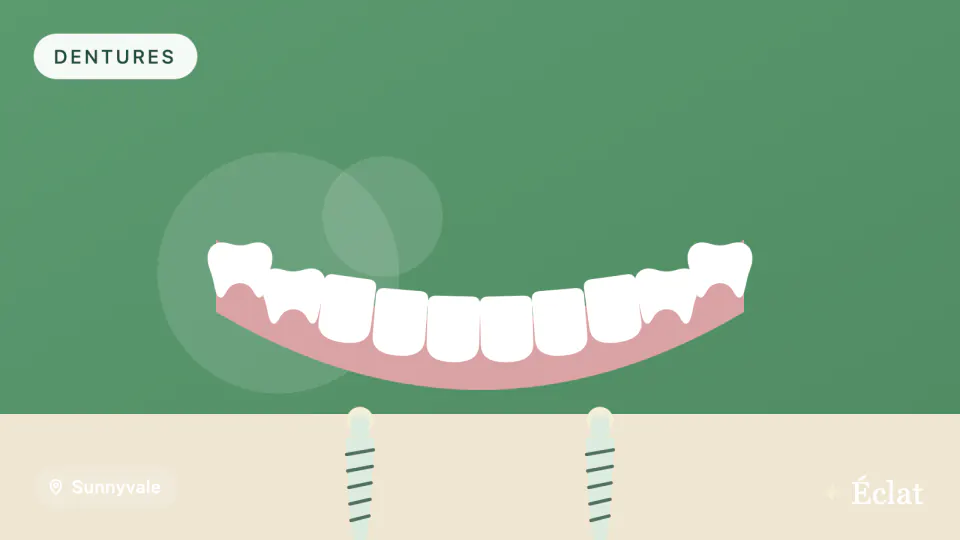
Snap-In Implant Dentures in Sunnyvale: Stability Over Regular Dentures
· Eclat Dental Studio
Snap-in implant dentures clip onto a few dental implants, so they move less than a regular denture. Here's how they work, who they suit, and what upkeep involves.
Opening soon: Eclat Dental Studio’s estimated grand opening is February 1, 2027.
A snap-in implant denture (an implant overdenture) clips onto a small number of dental implants. That anchoring usually makes it noticeably steadier than a regular denture, especially in the lower jaw, where conventional dentures tend to move the most. It is a good fit for many people who are missing all their teeth in one arch, but it involves surgery, a healing period, and ongoing maintenance. This guide covers the trade-offs for readers in Sunnyvale and nearby cities.
How does a snap-in denture differ from a regular denture?
A regular complete denture rests on the gums and relies on suction, saliva, and the shape of the ridge to stay in place. Over time the jawbone under a denture slowly shrinks, and the fit loosens. Many people end up adjusting what they eat, and some turn to adhesives.
A snap-in denture adds two or more implants placed in the jawbone. Small attachments on those implants, such as ball-type or low-profile locator-style connectors, click into matching housings inside the denture. The denture still rests on the gums, but it can't shift or lift as easily. You remove it daily for cleaning, the same way you would a regular denture.
This is different from a fixed implant bridge, which stays in the mouth and is only removed by a dentist. Snap-in dentures usually need fewer implants, so the surgery is often simpler and the overall treatment less extensive.
What does the research say about stability and comfort?
Snap-in dentures have been studied for decades. A consensus statement from the early 2000s (the 2002 McGill consensus) recommended a two-implant overdenture as a first-choice option for a fully toothless lower jaw, mainly because conventional lower dentures are often unstable and uncomfortable. Research since then points in a similar direction. People with implant overdentures generally report better stability, easier chewing, and higher satisfaction than people with conventional dentures.
Bone is another consideration. Some studies suggest implants in the front of the lower jaw may help limit the bone loss that happens under a regular denture, though results vary and the evidence is mixed. Survival rates also vary from study to study. Much of this evidence comes from reviews rather than large trials, so a dentist will discuss it with you as a likelihood, not a guarantee.
What are the risks?
Implant treatment is a surgical procedure, and it carries risks. These include infection, implant failure, and inflammation of the tissue around an implant (peri-implantitis). Some implants may need to be revised or replaced, and healing varies from person to person. A dentist can explain these risks and how they apply to your health history before you decide.
Is a snap-in denture right for you?
Dentists typically consider a few things when deciding if a snap-in denture suits someone:
- Which jaw: The lower jaw is the classic case, since lower dentures are the hardest to keep steady. Upper dentures are often tolerated reasonably well. When an upper overdenture is chosen, it usually uses more implants, often joined by a bar.
- Bone volume: Enough healthy bone is needed for the implants. 3D (CBCT) imaging lets a dentist evaluate bone height and width before planning.
- General health: Gum health, smoking, diabetes control, and certain medications can affect healing.
- Your goals: Some people want a fixed set of teeth. Others prefer a removable option that is easier to clean and needs fewer implants.
For many patients, dental implant care that includes careful surgical planning and gum-health maintenance can support longer-lasting results.
What upkeep should you expect?
Snap-in dentures are not maintenance-free. The small plastic or nylon inserts that grip the attachments wear with daily use, and the denture gradually feels looser. Studies commonly describe this as the most frequent maintenance need, and replacing the inserts is usually a quick chairside visit. Because the jawbone and gums can still change under the denture, it may also need relining or adjusting over the years.
- Clean the denture and the attachments daily, and brush the gums and implant areas gently.
- Take the denture out at night, as your dentist advises.
- Plan on regular checkups, often yearly or more often, to check the inserts, the fit, and the gum tissue around each implant.
Poor hygiene around the implants can lead to gum inflammation, so cleaning habits matter as much as the hardware.
Visiting from Sunnyvale
Many people ask whether treatment can fit around work and caregiving, and appointments are scheduled with that in mind. Treatment usually unfolds in stages: an exam and imaging, implant placement, a healing period, and then the denture attachments. Most steps are brief, and our Mountain View office is a short drive from Sunnyvale.
Cost depends on how many implants are needed, the attachment type, the condition of your existing denture, and lab fees. Ask our team about cost estimates and payment options after your consultation. Our office accepts all PPO dental plans and is in-network with Delta Dental, but coverage for implant treatment varies by plan, so verify your benefits with your plan.
Common questions about snap-in implant dentures
Q: Will a snap-in denture feel like natural teeth?
A: Not exactly. It is firmer than a regular denture, but it still rests partly on the gums, so you may notice a little movement, particularly with very sticky or hard foods.
Q: Can I convert my current denture into a snap-in?
A: Sometimes. If the existing denture fits well and is in good condition, a dentist may be able to adapt it. Otherwise a new denture is made to fit the attachments.
Q: How many implants do I need?
A: It varies. Two implants are common for the lower jaw. The upper jaw often calls for more, depending on bone and the design of the denture.
Q: How long does it take?
A: Timelines depend on healing and your bone. Some cases move faster than others, so a dentist will give you a realistic schedule after your exam.
Ready to talk it through?
If your denture slips or limits what you eat, a consultation can show whether snap-in implants make sense for you. Our team speaks English, Mandarin, Cantonese, and Spanish and welcomes patients from Sunnyvale and nearby cities. Call (650) 917-8348 or visit eclatdentalstudio.com to schedule a visit at our Mountain View office.
This article is general education, not a diagnosis or individual advice; a dentist must evaluate your mouth and health history.