Invisalign, Veneers or Bonding for Crooked Teeth: How Los Altos Hills Patients Can Decide
· Eclat Dental Studio
For Los Altos Hills patients with crooked teeth: how aligners, veneers and bonding differ, the questions that point to each, and when combining them makes sense.
When teeth look crooked, there are two broad ways to change that. You can move the teeth into better positions, or you can change the surfaces people see so the teeth appear straighter. Invisalign does the first; veneers and bonding do the second. Both approaches are legitimate, but they suit different situations, and choosing well starts with understanding what each one actually changes. This guide sets out how we help patients from Los Altos Hills and nearby make that decision.
Position or surface?
The single most useful question is this: are your teeth well shaped and a good colour but in the wrong places, or are they roughly in the right places but the wrong shape or shade?
- If position is the issue, it is at heart an orthodontic problem, even though you notice it cosmetically. Moving the teeth tends to be the more lasting and conservative answer.
- If the surface is the issue, such as chips, worn edges, deep discolouration or small misshapen teeth, veneers or bonding can do something aligners cannot.
- If it is both, the answer is often a sequence rather than a choice.
The three options in brief
Invisalign
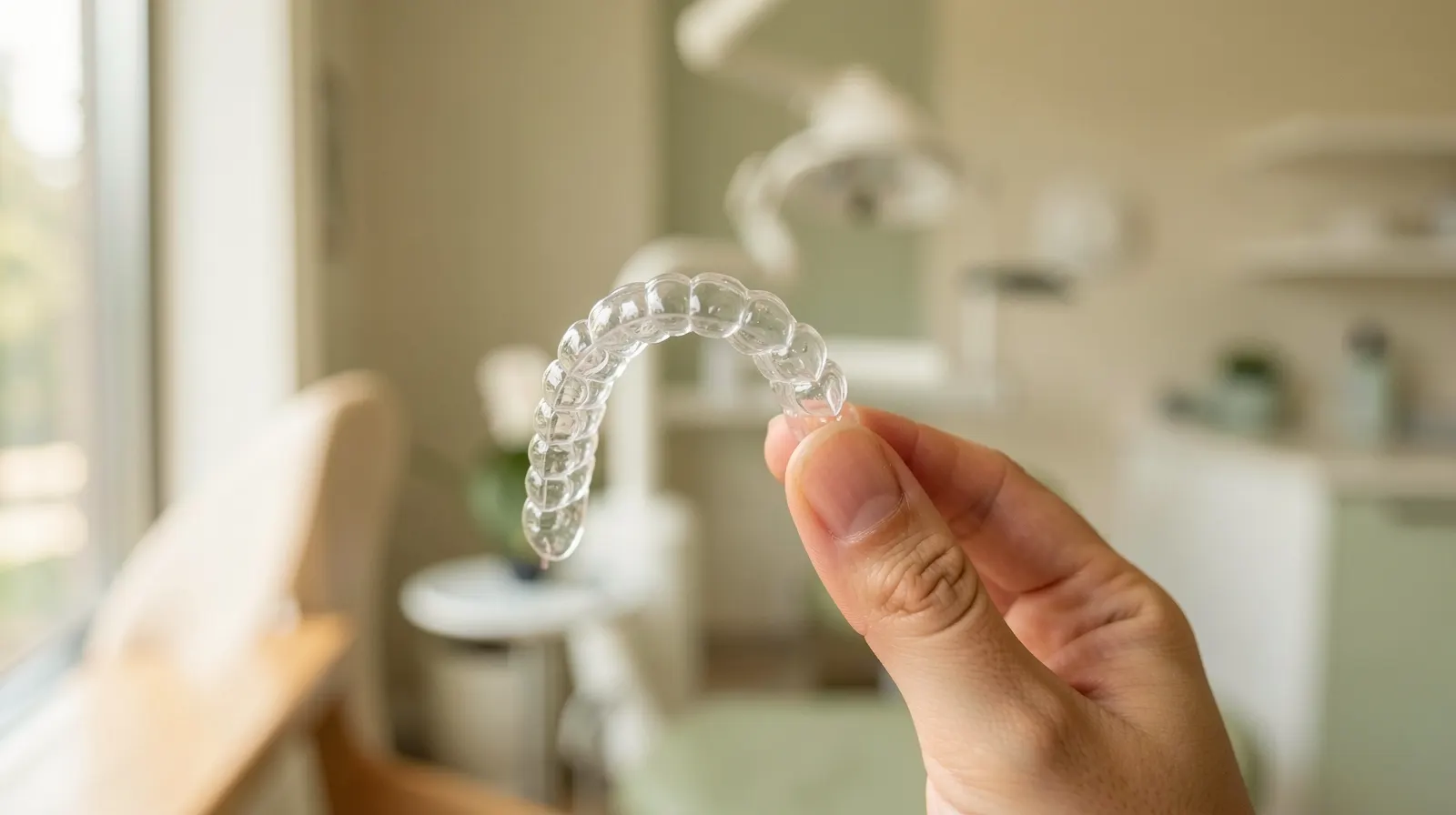
Clear aligners move teeth gradually through a series of trays. They work well for mild to moderate crowding or spacing, gentle rotations, and bites that do not need surgery. Their great advantage is that nothing permanent is removed from the teeth. The small attachments used during treatment come off at the end and the enamel is left as it was. Heavily rotated teeth are harder to predict with aligners alone. You can read more on our Invisalign page.
Composite bonding
Bonding uses tooth-coloured resin sculpted directly onto the tooth and hardened with a light. It usually needs little or no removal of enamel and can often be done in a single visit. It is ideal for small refinements: a slight overlap, a narrow gap, one tooth that looks a little short. It does stain more readily than porcelain and generally needs touching up or replacing after several years. It cannot disguise significant crowding.
Porcelain veneers
Veneers are thin porcelain shells bonded to the front of the teeth. They can change shape, size and colour together, and porcelain resists staining very well. The key caveat is that most veneers require removing a thin layer of enamel, which is irreversible. The more crooked the tooth, the more enamel may need to come off to make the veneer look straight. Our comparison of bonding and veneers goes into the materials in more depth.
Five questions that point toward an answer
- How crooked are the teeth? Mild irregularity can be disguised well; significant crowding or rotation is usually better moved.
- Are you happy with the colour and shape? If yes, moving the teeth may be all you need. If not, a surface treatment may be part of the plan.
- How do you feel about altering healthy enamel? Some people are comfortable with that trade-off; others would rather keep their natural teeth intact.
- Do you grind or have a deep bite? Heavy forces can chip or loosen veneers, so these often need to be addressed first.
- What is your timeline? Bonding can be finished in a day, veneers in a few visits, and aligners over months.
When combining them makes sense
For patients who want teeth that are both straight and refined in shape or colour, a common approach is to align first and restore second. Invisalign brings the teeth into better positions; after a short settling period, often around two to four weeks, any remaining cosmetic work is planned on teeth that are already where they should be.
This order has practical benefits:
- Well-positioned teeth can usually be veneered with far less preparation, so the bond stays mostly in enamel.
- Veneers bonded to enamel on stable teeth tend to last better. Long-term reviews have reported survival of around 95 percent at ten years in those conditions.
- Patients frequently need fewer veneers than they expected, or find that bonding on one or two teeth is enough.
- The new tooth positions are tested in plastic before anything permanent is placed.
Whichever route you take, teeth can shift over time, with or without veneers, so a retainer is part of the long-term plan.
When a single option is enough
- Aligners alone when the teeth are healthy, a good shade and well shaped, and simply out of line.
- Bonding alone when one or two teeth have small irregularities that resin can smooth out.
- Veneers alone when teeth are already fairly straight and the concern is colour, wear or shape.
Common questions
Can veneers fix very crooked teeth?
They can work for mild to moderate irregularity, but disguising severe crowding usually means heavy tooth reduction and a less natural result. Moving the teeth first is generally wiser.
Is one crooked front tooth better bonded or veneered?
Bonding is often the conservative starting point. A veneer becomes more attractive if you also want to change the tooth's shape or colour for the long term.
Will insurance help?
Treatment done purely for appearance is not usually covered, though some plans include orthodontic benefits. We can check your PPO plan before you decide.
Seeing your options side by side
The clearest way to decide is to look at your own teeth with someone who will lay out every option honestly. At our Mountain View studio we can scan your teeth, preview how aligners would move them, and discuss whether any cosmetic finishing would still be needed. Our smile design page explains how that planning works. The studio is an easy trip from Los Altos Hills by Foothill Expressway or Highway 280; call to arrange a consultation.