Invisalign in Palo Alto: Attachments, IPR and Refinements Explained
· Eclat Dental Studio
For Palo Alto patients who want the mechanics: what Invisalign attachments do, why teeth are sometimes gently reshaped, and why refinement aligners are a normal part of treatment.
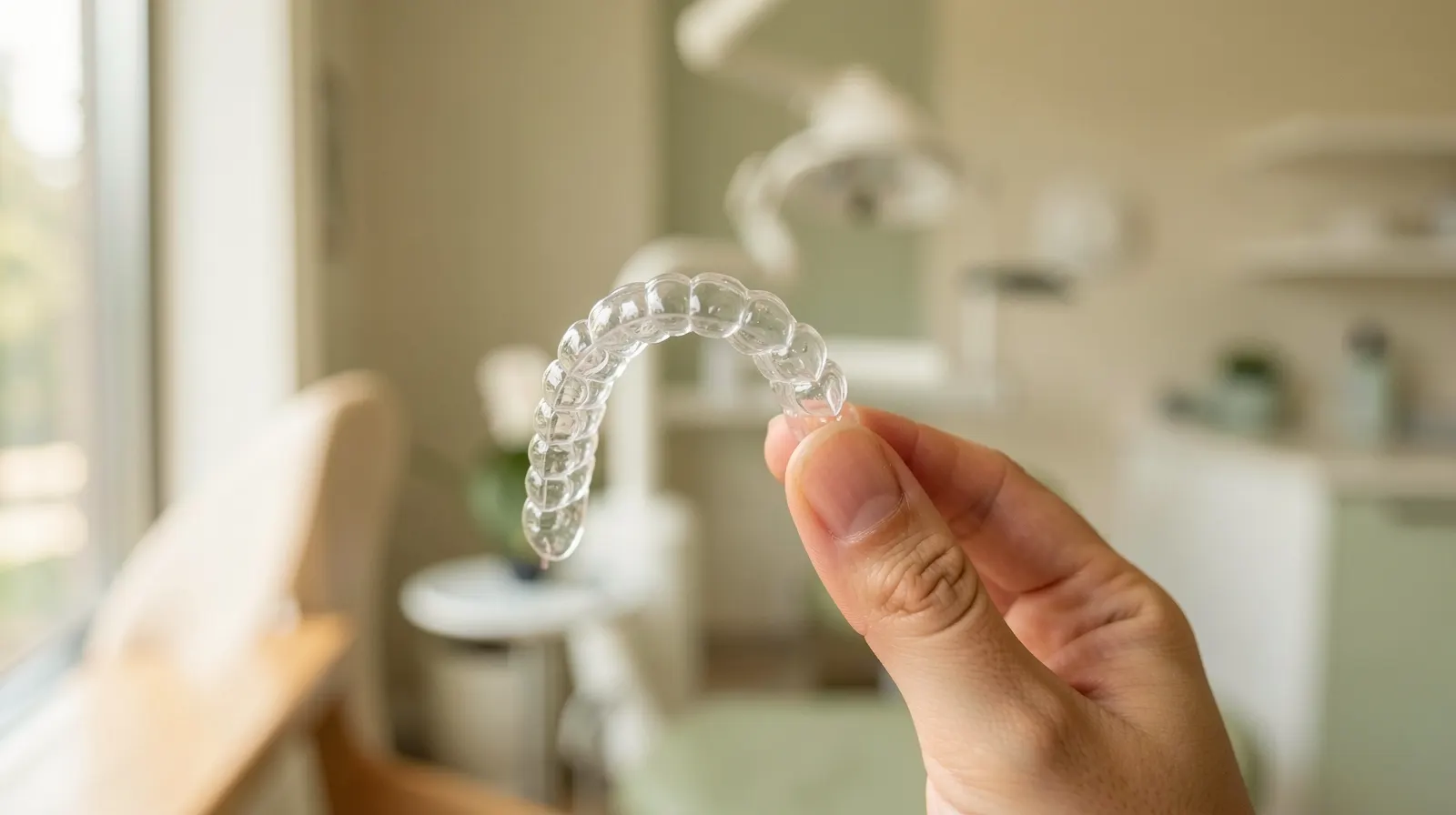
Clear aligners look simple: a series of thin plastic trays, each slightly different from the last. The engineering underneath is less obvious. Palo Alto patients often ask about the small bumps on their teeth, the gentle polishing between teeth, and the extra set of trays near the end. This article explains those three features, attachments, interproximal reduction and refinements, and why each exists.
Why plastic alone is not always enough
An aligner moves a tooth by pressing on its surface. For a tooth that only needs to tip slightly, a smooth tray can do that easily. Many movements are harder: rotating a rounded tooth, pulling a tooth down or pushing it up, or moving the root rather than just the crown. For those, the tray needs something to push against.
Attachments: handles for the aligner
Attachments are small, tooth-coloured shapes bonded to selected teeth. They are made from the same kind of composite used for fillings and bonding. Each one is shaped and angled according to the movement planned for that tooth, and the aligners are made to grip them.
- Placement is quick and does not require numbing. A template tray positions them accurately.
- Appearance is subtle. They match the tooth colour and are hard to see at conversation distance.
- Removal happens at the end of treatment. They are polished off and the enamel beneath is left smooth.
Not every tooth needs one, and some cases need very few. Rounded teeth such as canines and premolars, which are notoriously difficult for aligners to rotate, are frequent candidates.
IPR: making a little room
Interproximal reduction, or IPR, is a careful polishing of the contact points between certain teeth to create a small amount of space. It is used when teeth are crowded and need somewhere to move, and it can also refine the shape of teeth that are wider at the edge than at the gumline, which helps reduce small dark triangles near the gums.
The amounts removed are small and planned in advance on the digital model. The procedure does not usually need anaesthetic. Patients often find it sounds more alarming than it feels. IPR is one of several ways to create space; others include expanding the arch slightly or tipping teeth, and the plan will choose among them.
Refinements: the fine-tuning phase
Every aligner plan is a prediction of how teeth will respond. Teeth are biological, and they do not always follow the prediction perfectly. Some movements, particularly rotations and root movements, tend to lag behind what was planned. When the first series of aligners is complete, we compare where the teeth are with where they were meant to be.
If there is a gap, a new scan is taken and a shorter additional series of trays is made. This is called a refinement. Published reviews suggest that more than half of aligner cases need at least one round, so it should be expected rather than treated as a problem. A small number of complex cases also finish with a short phase of another technique to complete certain movements.
What you can do to reduce refinements
- Wear time. The trays need to be in for 20 to 22 hours a day. Shortfalls show up as teeth that do not track.
- Seat the trays fully. Small chewable cushions, sometimes called chewies, help press aligners fully onto the teeth and attachments.
- Tell us about gaps. If you see space between a tray and a tooth, mention it early. Catching it partway is easier than correcting it at the end.
- Keep attachments intact. If one comes off, call so it can be replaced before it affects movement.
How this affects the timeline
Refinements add weeks or months, depending on how much fine-tuning is needed. Our article on how long Invisalign takes includes refinements in its typical ranges, which gives a more realistic picture than the initial tray count alone.
Finishing well
At the end, attachments are removed, the teeth are polished, and retainers are made to hold the result. Some patients combine the finish with bonding or whitening to refine tooth shape or colour once alignment is complete.
A consultation built around your case
At the first visit we examine your bite, take a digital scan and show you what movements your plan would involve, including whether attachments or IPR are likely. The studio is in Mountain View on Showers Drive, a straightforward trip from Palo Alto along El Camino Real or Central Expressway. Visit our Invisalign page or call (650) 917-8348 to book.