Choosing a Veneer Material: A Guide to Porcelain Types for Menlo Park Patients
· Eclat Dental Studio
Feldspathic, leucite-reinforced and lithium disilicate (e.max) veneers compared: strength, translucency, long-term data, and why the bond to enamel matters most.
"Porcelain veneer" sounds like a single product, but the word covers several different ceramics, each with its own balance of strength and beauty. Patients from Menlo Park who have done some reading often arrive with questions about e.max, feldspathic porcelain or cheaper resin alternatives. This guide sets out what each material is, what the long-term research says about it, and how we decide which suits a particular smile.
The short version
Well-made ceramic veneers of any of the main types have a high chance of lasting a decade or more. Where the materials differ is less in whether they survive and more in how often they need small repairs, and in how they handle light. Lithium disilicate is the stronger, lower-maintenance option; feldspathic porcelain offers the most delicate translucency. Above all, the long-term outlook depends on whether the veneer is bonded to healthy enamel.
What the long-term data shows
A systematic review and meta-analysis published across 2024 and 2025 pooled results from close to 8,000 veneers followed for around ten years. Survival was approximately 96% for feldspathic porcelain, 94% for leucite-reinforced ceramic and 97% for lithium disilicate, and the differences between them were not statistically significant.
The materials separated more clearly on technical complications, a broad category that includes small chips, fine cracks, staining along the margin and minor repairs. Lithium disilicate showed a rate of around 6%, compared with roughly 41% for feldspathic porcelain over similar follow-up. Most of those events were cosmetic touch-ups rather than lost veneers, but they do mean more maintenance visits.
Pooled across materials, outright fracture occurred in roughly 2.5% of veneers and complete debonding in about 2.2%. These are averages from many practices and patients, so individual outcomes vary with bite, hygiene and how the tooth was prepared.
The ceramics, one by one
Feldspathic porcelain
A ceramist builds feldspathic veneers by hand, layering fine porcelain powder and firing it in stages. The result can be extremely thin and lets light pass through much like natural enamel, including the subtle translucent halo at the biting edge.
- Strengths: the highest cosmetic ceiling, very thin sections, excellent for conservative front-tooth cases.
- Trade-offs: more brittle, more sensitive to heavy biting forces, and more prone to small chips and marginal staining over a decade.
- Best suited to: a small number of upper front teeth on healthy enamel, in someone who does not clench or grind.
Leucite-reinforced ceramic
This is a glass-ceramic strengthened with leucite crystals. It sits between feldspathic porcelain and lithium disilicate in strength and has a long clinical history. In the pooled data its survival was slightly lower, though not significantly so. Today it is chosen less often, largely because lithium disilicate offers more strength with comparable appearance.
Lithium disilicate (e.max)
Lithium disilicate is a glass-ceramic with much higher flexural strength than traditional porcelain. It is pressed or milled rather than layered, although a ceramist can still add surface characterisation, and it now comes in a wide range of shades and translucencies. In ordinary lighting, a skilled laboratory can make it very hard to tell apart from natural enamel.
- Strengths: resists chipping even at thin edges, very low long-term complication rate, predictable.
- Trade-offs: slightly less light transmission than the finest hand-layered feldspathic work.
- Best suited to: edge-to-edge bites, patients with some grinding who will wear a night guard, veneers that wrap over the biting edge or rebuild worn tips, full-smile cases, and single veneers beside existing crowns.
What about resin veneers?
Composite and printed resin veneers cost less initially, and composite can be applied directly in one visit. A 2026 laboratory fatigue study tested veneers under repeated simulated chewing: lithium disilicate lasted an average of about 950,000 cycles, injection-moulded composite about 460,000, and 3D-printed resin about 135,000. Bench testing is not the same as years in a mouth, but it is consistent with the clinical picture and is one reason we generally recommend ceramic when longevity is the priority. For small changes, direct bonding remains a useful and conservative option.
The factor that outweighs the material
One of the most consistent findings in the research is that where a veneer is bonded matters more than which ceramic it is made from. Veneers bonded entirely to enamel show long-term survival in the region of 96 to 97%. Once more than about 30% of the bonded surface is dentin, the risk of failure rises several-fold. For patients who grind without wearing a protective splint, fracture risk was reported as roughly seven times higher than for those who wore one.
In practical terms, that means conservative preparation and a night guard where needed will do more for your veneers than the choice between two good ceramics. Teeth that are heavily worn, deeply discoloured, previously crowned or covered with old bonding are harder to treat predictably, and need a careful assessment first.
How we match material to the smile
- For most full-smile cases and any veneer that covers the biting edge, we lean towards lithium disilicate.
- For a few highly visible front teeth on healthy enamel, in a patient without heavy clenching, feldspathic porcelain is a strong option with an experienced ceramist.
- For every case, the plan starts with protecting enamel and the bond.
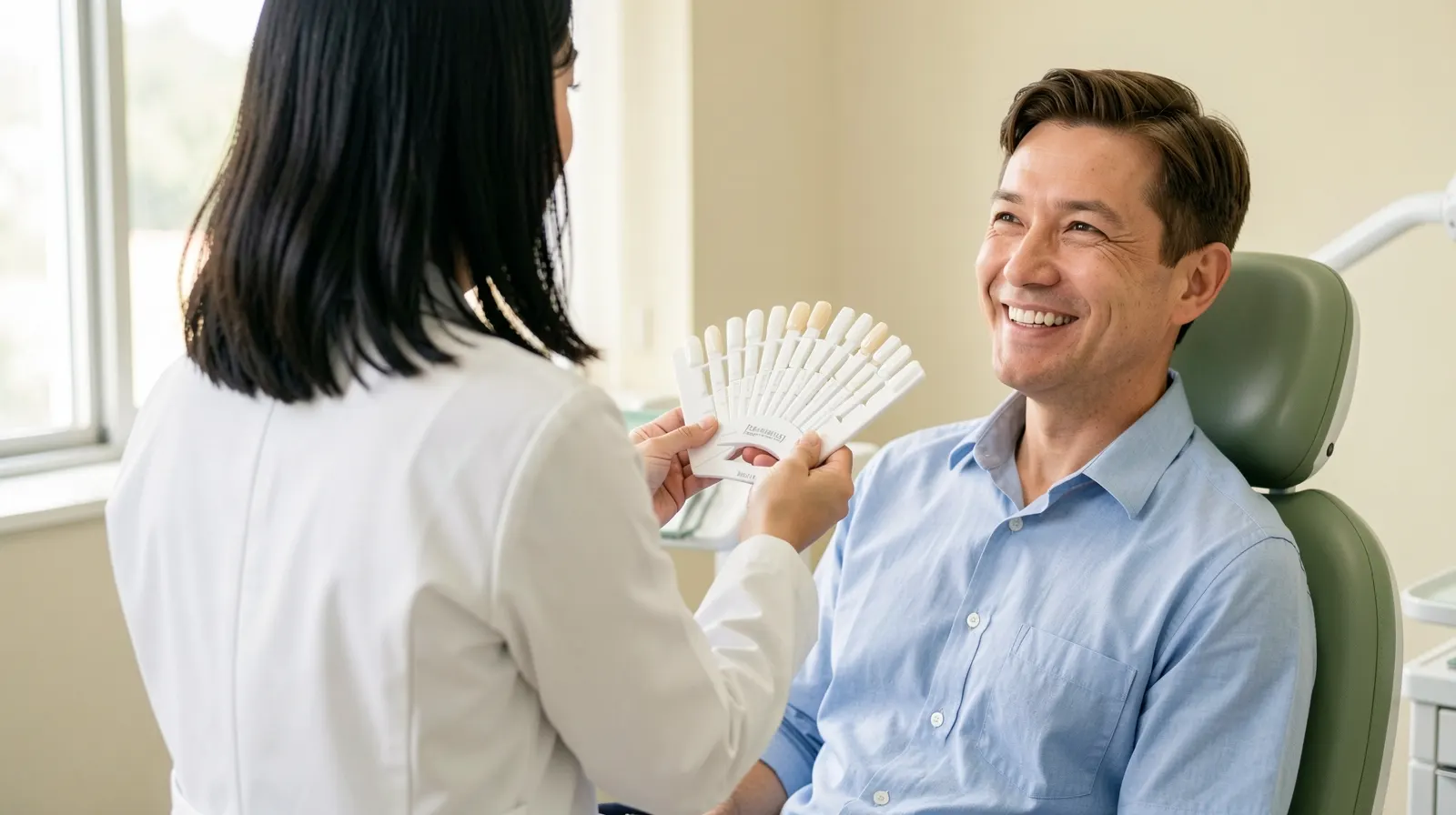
We explain our reasoning at the consultation and show you examples of each material, so the decision is one you understand rather than one made on your behalf.
Common questions
Is feldspathic porcelain outdated?
Not at all. It remains a first choice for some cosmetically demanding front-tooth cases. It simply suits a narrower group of patients.
Will e.max veneers last twenty years?
Many do, but high-quality data currently extends to around ten to fifteen years, with survival in the mid to high nineties. Bite habits, hygiene and night guard use matter as much as the material.
Can a chipped veneer be repaired?
Small chips can often be polished or repaired with composite. Larger fractures usually mean replacing that veneer.
Does the material change the number of visits?
Not usually. Both are made in a laboratory from a scan, and the appointment sequence is described in our step-by-step veneer guide.
Talk it through with us
Eclat Dental Studio is in Mountain View, reached from Menlo Park along El Camino Real or Highway 101. Bring your questions about materials to a consultation, or read more on our cosmetic dentistry page. You can reach us at (650) 917-8348.